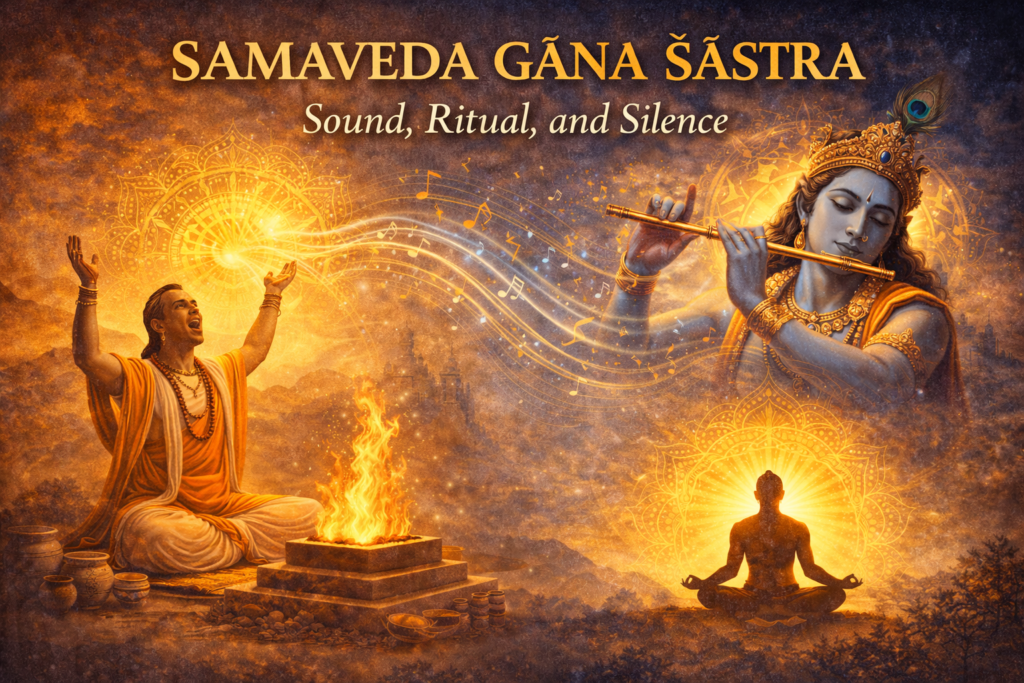
Sound, Ritual, and Silence
Introduction: Why Samaveda Is Not Music
Among the four Vedas, the Sāmaveda occupies a position that is consistently misunderstood. It is often described incorrectly as the “Veda of music” a characterization that arises from superficial similarity between its chant-forms and later Indian musical traditions. In reality, Sāmaveda is not music, nor is it intended for aesthetic enjoyment, emotional expression, or artistic improvisation. It is a ritual sound-science, developed for one purpose alone – the effective operation of the Soma-yajña.
Where the Ṛgveda invokes deities through meaning-bearing hymns, and the Yajurveda operationalizes ritual through precise action, the Sāmaveda transforms sound itself into a functional ritual instrument. In this system, semantic meaning becomes secondary, and in many contexts irrelevant. What matters is pitch, duration, sequence, breath, and silence. A mantra sung with incorrect svara is not “less effective” it is considered ritually invalid.
This fundamental shift – from meaning to vibration – marks Sāmaveda as a distinct epistemic system within Vedic thought. To understand it, one must suspend modern assumptions about music, devotion, and performance, and instead enter a worldview in which sound regulates time, breath, and cosmic order (ṛta).
The Ontological Status of Sound in Sāmaveda
In Sāmaveda, sound is not a carrier of meaning it is a mode of action. The Brāhmaṇa literature repeatedly emphasizes that yajña succeeds not because of intention or belief, but because of correct execution. Sound, when properly produced, acts directly upon the ritual field.
This explains why most Sāmaveda mantras are borrowed from the Ṛgveda. The Ṛgvedic hymn provides the verbal substrate, but once absorbed into the Sāmavedic corpus, the mantra is no longer treated as speech. It is stretched, fragmented, repeated, and interwoven with non-lexical syllables (stobhas). Through this process, language is deconstructed and sound is liberated from conceptual constraint.
The ontological shift is decisive:
- In Ṛgveda, mantra = meaningful utterance
- In Sāmaveda, sāman = vibrational structure
This is why Sāmaveda cannot be “translated” in any meaningful sense. Translation preserves meaning, Sāmaveda operates beyond meaning.
Fundamental Principle of Sāmaveda Singing
Sāmaveda = Rig mantra + musical transformation (Sāman)
- The words come mostly from Ṛgveda
- The soul comes from svara (musical notes)
- Meaning is secondary to correct sound vibration
Wrong svara = mantra becomes ineffective
That is why Sāmaveda is traditionally learned only orally from a Guru.
Sound as Ritual Technology (Brāhmaṇa Framework)
The Pañcaviṃśa Brāhmaṇa (Tāṇḍya Mahābrāhmaṇa) provides the most systematic exposition of Sāmaveda’s ritual role. It describes how elongation (pluti), repetition, and segmentation of sound align the chant with ritual time-units (mātrā). Time in yajña is not clock-time, it is generated and sustained by sound.
A Sāman, when sung correctly, stretches a short Ṛgvedic mantra across a much longer temporal field. This temporal expansion allows the ritual action (pressing Soma, offering oblations) to synchronize with cosmic rhythms. The chant does not accompany the ritual it governs it.
The Brāhmaṇa texts are uncompromising on this point:
- Early chanting causes energy leakage
- Late chanting causes ritual rupture
- Incorrect pitch causes symbolic injury to yajña
Thus, the Udgātṛ (Sāmaveda priest) bears extraordinary responsibility. His task is not artistic performance, but temporal governance.
Śikṣā and the Absolute Necessity of Oral Transmission
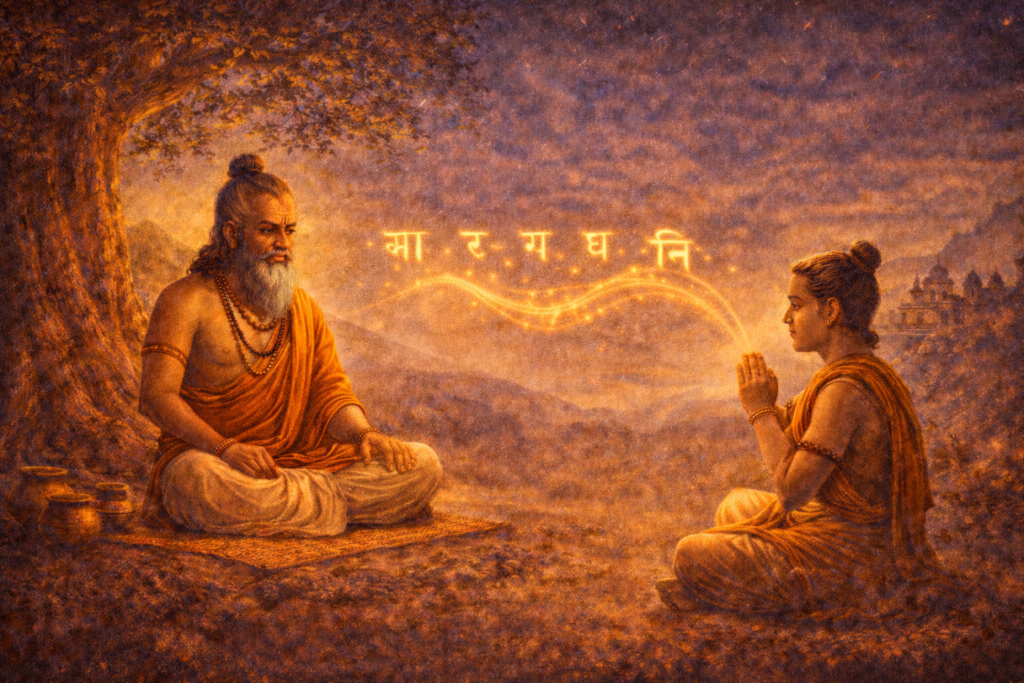
Sāmaveda is preserved exclusively through oral transmission (guru–śiṣya paramparā). This is not cultural conservatism it is functional necessity. Written notation cannot encode:
- micro-stability of pitch
- breath continuity across elongations
- embodied memory of svara
Sāmavedic śikṣā focuses on the body as instrument. The student is trained to stabilize the chest, regulate breath, and hold pitch without oscillation. Emotional fluctuation is explicitly discouraged because it destabilizes svara.
A deviation that might be musically acceptable elsewhere is here classified as doṣa (ritual fault). This is why gurus traditionally correct students without verbal explanation—by re-chanting correctly and allowing the student’s body to adjust.
Eligibility & Inner Preparation (Adhikāra)
Before singing Sāmaveda, traditionally one must:
- Be physically and mentally pure
- Have done snāna (bath)
- Sit facing east or north
- Perform ācamana
- Maintain silence and concentration
Sāmaveda singing is yajña-oriented, not performance-oriented.
Basic Musical System of Sāmaveda
🎵 Sāmaveda has 7 svaras (notes)
| Sāmaveda Name | Approximate Modern Note |
| Prathama | Sa |
| Dvitīya | Re |
| Tṛtīya | Ga |
| Chaturtha | Ma |
| Pañcama | Pa |
| Ṣaṣṭha | Dha |
| Saptama | Ni |
⚠️ These are not exactly Carnatic or Hindustani notes—Sāmaveda svaras are ritual sounds, not rāga-based music.
Key Features of Sāmaveda Singing
1️⃣ Elongation (Pluta)
- Vowels are stretched
- Example:
Agniṃ īḷe purohitaṃ
↓
Aaaa-gniiiii-m īīī-ḽeeee
2️⃣ Repetition (Abhyāsa)
- Words are repeated
- Sometimes syllables are split
3️⃣ Insertion of Stobhas
Stobha = musical filler syllables
Common stobhas:
- hā
- ho
- hu
- vā
- o
- ī
Example:
Agnāyi → hā agnāyi ho
⚠️ Stobhas have no meaning, only musical and ritual function
The Structure, Internal Architecture of a Sāman
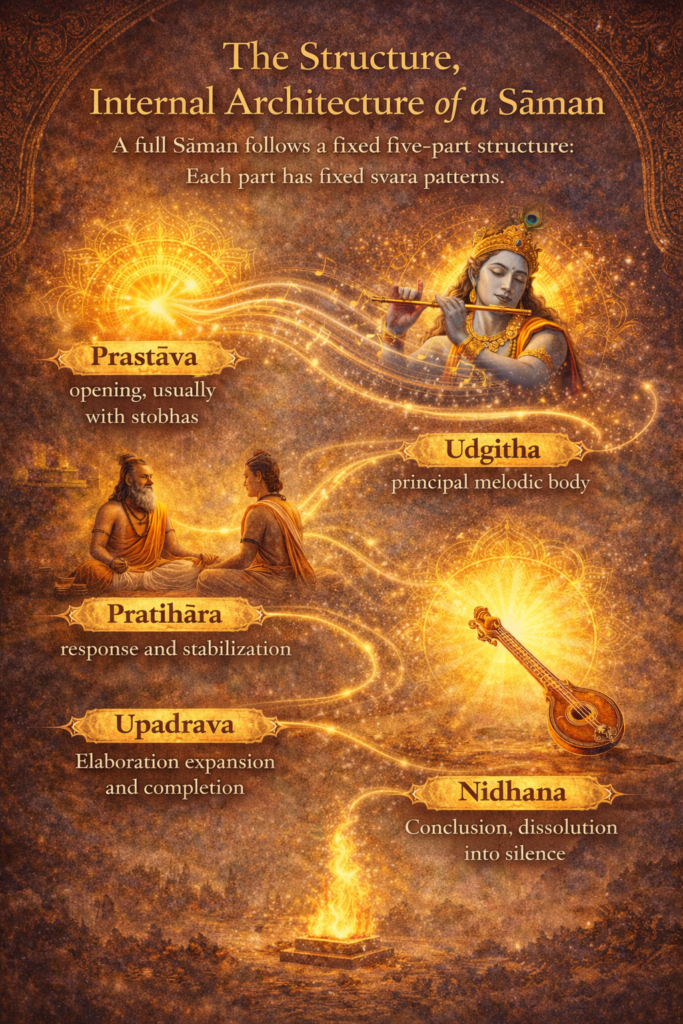
A full Sāman follows a fixed five-part structure: Each part has fixed svara patterns.
- Prastāva – opening, usually with stobhas
- Udgītha – principal melodic body
- Pratihāra – response and stabilization
- Upadrava – Elaboration expansion and completion
- Nidhana – Conclusion, dissolution into silence
This structure is not optional or stylistic. It is ritually mandated and attested in Brāhmaṇa texts. The most misunderstood element is Nidhana. Modern readers assume the chant “ends” with sound. In Sāmaveda, this is false.
The chant ends in silence.
Speaking, moving, or immediately transitioning after Nidhana is traditionally considered a fault, because silence itself is the final offering.
Stobhas and the Liberation of Sound from Meaning
Stobhas—syllables such as hā, ho, ī, vā—are often dismissed as meaningless fillers. This is a serious misunderstanding. Stobhas perform three critical functions:
- Breath regulation – they structure inhalation and exhalation
- Temporal extension – they stretch the chant into ritual time
- De-semanticization – they sever sound from language
The Jaiminīya Brāhmaṇa interprets stobhas not as words, but as vehicles of prāṇa. By removing meaning, the chant bypasses intellect and acts directly on physiological and ritual processes.
This is why stobhas are never translated, never altered, and never replaced.
Main Chanting Styles (Pāṭhas)
1️⃣ Gāna (Singing form) – Actual Sāmaveda
- Used in Soma Yajña
- Fully musical
- Long elongations
- Includes stobhas
2️⃣ Ārchika / Grāma-geya / Araṇya-geya
- Transitional forms
- Used for learning
Udgītha and the Solar Principle
The Chāndogya Upaniṣad declares:
Udgītho vai ādityaḥ
“The Udgītha is the Sun.”
This statement is not metaphorical. The melodic arc of a Sāman—ascending, stabilizing, descending—mirrors the solar trajectory. Just as the Sun regulates cosmic time, the Udgītha regulates ritual time.
This is also why Sāmaveda chanting is traditionally aligned with daylight ritual contexts and not treated as free-form devotional singing.
From External Yajña to Internal Upāsanā
The Upaniṣads represent not a rejection of Sāmaveda, but its interiorization. The external Soma sacrifice is transformed into an inner discipline. The Udgītha becomes OM, and the ritual breath becomes meditative breath.
The famous injunction:
Om iti udgītham upāsīta
“Meditate on OM as the Udgītha”
preserves the Sāmavedic structure while relocating it inward. Sound still dissolves into silence only the altar has moved.
Silence as Completion, Not Absence
In modern frameworks, silence is absence. In Sāmaveda, silence is completion. The chant does not aim to produce sound indefinitely, it aims to arrive at stillness through sound.
This principle is the philosophical culmination of Sāmaveda. It explains why Upaniṣadic thought—concerned with interior realization—emerges so naturally from the Sāmavedic tradition.
Lineages, Decline, and Survival
Two primary Sāmaveda lineages survive today. Each has different melodies for the same mantra.
- Kauthuma–Rāṇāyanīya
- Jaiminīya
They represent independent melodic grammars and must never be mixed. The decline of Soma-yajña, loss of patronage, and misclassification of Sāmaveda as “music” led to the disappearance of most traditions. What survives today does so in small, fragile lineages, effectively functioning as living archives.
Samaveda as Re-tuning
Sāmaveda does not seek emotional devotion, philosophical argument, or even liberation as an explicit goal. Its function is subtler and more radical: retuning the human instrument to cosmic order (ṛta).
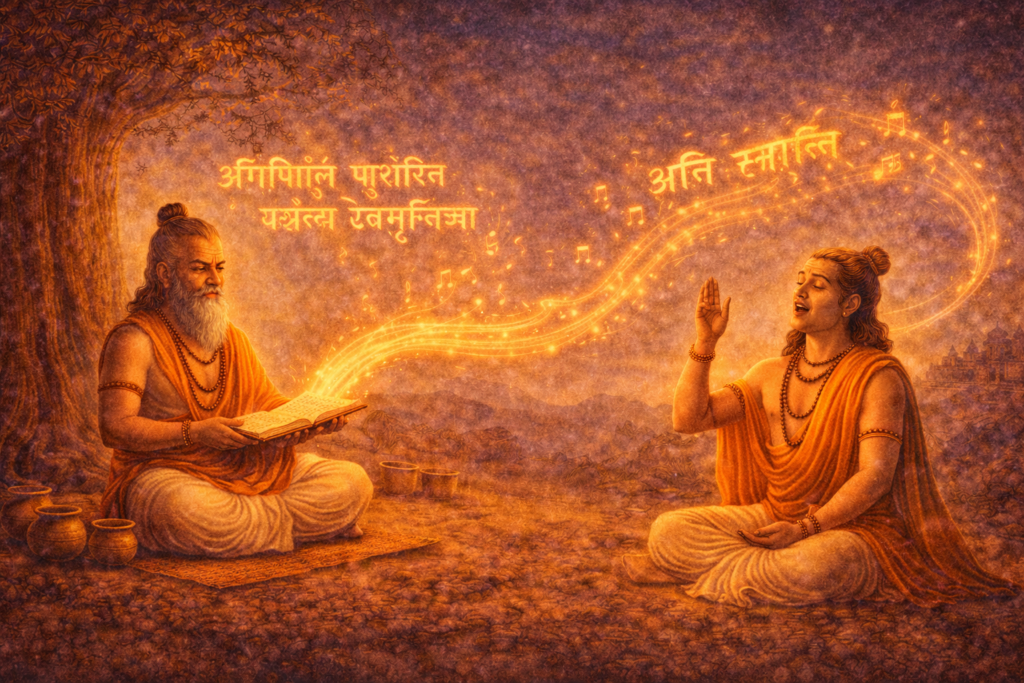
When the tuning is complete, sound naturally dissolves into silence.
That silence is not emptiness. It is correctness.
How One Mantra Becomes a Sāman
Ṛgveda mantra:
agním īḷe purohitaṃ
Becomes (simplified illustration):
hā āāgniiiiiṃ ho īīḽeeee
puroooo hitaaam
➡️ This is not free singing — every rise and fall is prescribed.
Rules (Very Important)
❌ No improvisation
❌ No rāga imagination
❌ No emotional expression
❌ No speed variation
✅ Absolute pitch control
✅ Guru-paramparā
✅ Breath discipline
✅ Svara purity
Why Sāmaveda is Sung (Philosophy)
- Considered origin of Indian music
- Chanting produces cosmic resonance
- Udgītha is equated with Prāṇa
- Sound itself is Brahman
“Udgītha is the Sun, the breath, and the essence of all beings” – Chāndogya Upaniṣad
How You Can Start Practically (Modern Way)
- Learn basic svara recitation (1–7)
- Listen to authentic recordings (Kauthuma / Jaiminīya)
- Practice one sāman daily, not many
- Never learn from notation alone
- Prefer direct oral transmission
Important Warning ⚠️
Reading text or YouTube alone cannot make you a Sāmavedin.
Without a Guru, only intellectual understanding is possible—not ritual competence.
SĀMAN-BY-SĀMAN PRACTITIONER
A Model Instructional Sāman (Agnāyi Sāman – Kauthuma Tradition)
This is intended for serious practitioners and teachers of Sāmaveda.
It does not attempt to replace oral transmission, nor does it claim ritual authorization. Its purpose is:
- to clarify structure, not melody
- to explain why each component exists
- to prevent common conceptual errors
- to make explicit where books must stop and guru must begin
This appendix uses one model Sāman as an exemplar. Understanding one Sāman correctly is more valuable than superficial familiarity with many.
1. The Rigvedic Source Mantra
The source mantra for this instructional Sāman is:
Ṛgveda 1.1.1
agním īḷe purohitaṃ
In the Ṛgveda, this mantra functions as a semantic invocation of Agni, the ritual priest and mediator. It is short, metrically compact, and meaning-centric.
In the Sāmaveda, this mantra ceases to function as a sentence.
2. Why the Mantra Must Be Transformed
A central error among beginners is the assumption that Sāmaveda is merely “singing the Ṛgveda.” This is false.
The transformation is required because:
- Ṛgvedic time is too short for Soma-yajña operations
- Ritual actions require sonic extension to remain synchronized
- Semantic language interferes with sustained breath and pitch
Therefore, the mantra is:
- elongated
- segmented
- repeated
- surrounded by non-semantic syllables
The result is not a song, but a sonic architecture.
3. Preliminary Requirement: Svara Before Mantra
No practitioner should attempt a Sāman before stabilizing svara memory.
In the Kauthuma tradition:
- svaras are learned without words
- the body learns pitch before the intellect learns form
If svara is unstable, all later practice is invalid, regardless of sincerity.
4. The Five-Part Architecture of the Sāman
Every Sāman follows a non-negotiable five-part structure. These are not aesthetic sections, they are functional ritual phases.
4.1 Prastāva – Establishing the Sonic Field
The Prastāva opens the Sāman using stobhas only.
Key characteristics:
- no mantra words
- slow, elongated sound
- breath stabilization
Purpose:
- establish pitch
- align breath
- prepare the ritual field
The Prastāva is comparable to preparing the altar, not offering oblation.
4.2 Udgītha – The Core Sonic Body
The Udgītha is the heart of the Sāman.
Here:
- the Rigvedic mantra enters
- but in transformed form
- fragmented, elongated, interwoven with stobhas
Important:
- the practitioner must not think of meaning
- articulation must remain relaxed
- pitch must remain absolutely stable
Any emotional coloring here is considered a technical fault, not devotion.
4.3 Pratihāra – Response and Stabilization
The Pratihāra responds to the Udgītha.
Its function is:
- to stabilize pitch
- to prevent drift
- to “answer” the sonic energy released
This section is often short, but extremely important.
Errors here propagate forward.
4.4 Upadrava – Completion Through Expansion
The Upadrava completes the mantra portion of the Sāman.
It often:
- carries the latter half of the Rigvedic source
- includes rising and descending pitch movement
- requires sustained breath control
The Upadrava must feel effortless.
Effort indicates incorrect preparation.
4.5 Nidhana – Dissolution Into Silence
The Nidhana is the most misunderstood part.
It is not an ending note.
It is a controlled withdrawal of sound into silence.
Rules:
- no speech after
- no movement after
- no immediate transition
Silence here is ritually active.
Breaking it is considered a fault.
5. The Role of Stobhas (Critical Clarification)
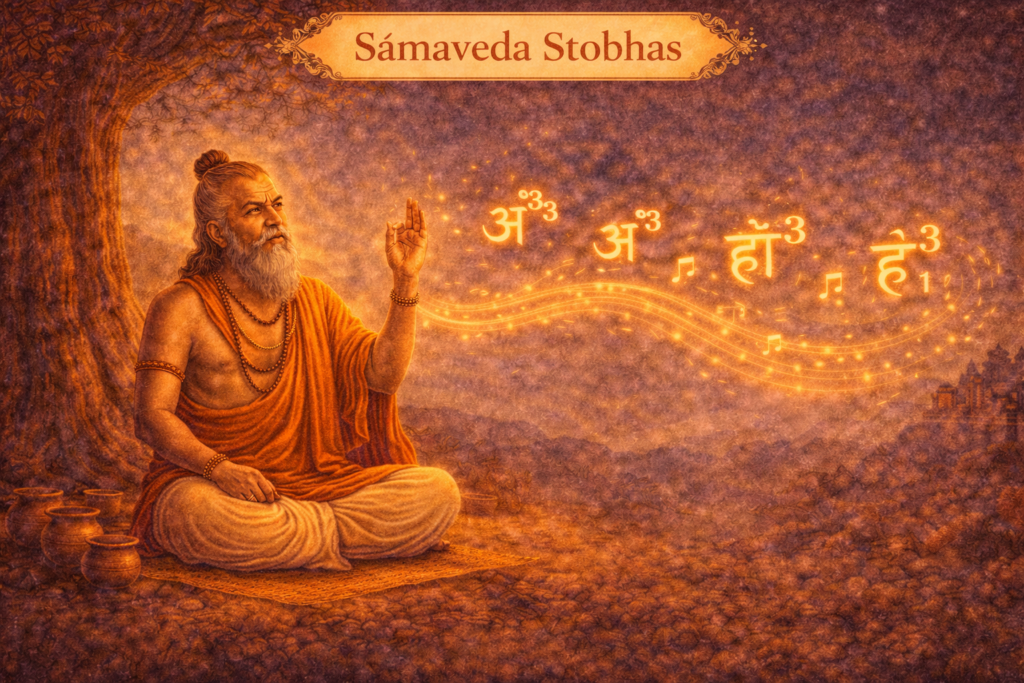
Stobhas (hā, ho, ī, vā, etc.) are not meaningless fillers.
They perform three essential functions:
- Breath governance
- Temporal extension
- Detachment from semantics
The practitioner must never:
- replace stobhas
- shorten them arbitrarily
- attempt to “understand” them linguistically
They function below meaning, at the level of prāṇa.
6. Silence as the Final Component of Practice
In Sāmaveda, practice does not end with sound.
True completion occurs only when:
- sound has dissolved
- breath is steady
- the practitioner remains still
This silence is not meditation added later. It is part of the Sāman itself.
7. Practice Discipline (Non-Negotiable Rules)
For householders and learners:
- Only one Sāman per session
- Never increase quantity
- Never rush tempo
- Never mix traditions
- Stop practice before fatigue
Violation of these rules leads not to progress, but to distortion.
8. Tradition Boundary: Kauthuma vs Jaiminīya
This appendix follows the Kauthuma–Rāṇāyanīya tradition exclusively.
The Jaiminīya tradition:
- uses different melodic grammar
- different stobha usage
- different pitch movement logic
They must never be mixed.
Mixing traditions is not synthesis it is loss of lineage integrity.
9. Final Practitioner Insight
A Sāman is successful not when it sounds beautiful,
but when nothing remains to be done after it.
If silence feels natural, the practice was correct.
If restlessness remains, something was wrong.
HOW TO SING ONE COMPLETE SĀMAN
Chosen Example
Ṛgvedic mantra (source):
agním īḷe purohitaṃ
(RV 1.1.1 – very sacred, ideal for beginners)
In Sāmaveda, this becomes Agnāyi Sāman (simplified instructional version).
STEP 1: Learn the Sāmaveda Svaras (Very Slowly)
First, do not sing the words.
Train the svaras alone.
Recite aloud (slow, steady breath):
1 2 3 4 5 6 7
Sa Re Ga Ma Pa Dha Ni
Now sing only three notes, because beginner Sāmans mostly use them:
Ma Pa Ma
4 5 4
⚠️ No shaking, no gamaka, no emotion.
STEP 2: Learn Stobhas
Before words, you must master stobhas.
Common beginner stobhas:
hā — ho — ī — vā
Practice chanting:
hāāā — hooo — īīī — vāāā
Each vowel must be elongated (pluta).
STEP 3: Structure of the Sāman you will practice
Every Sāman has 5 fixed parts.
We will sing all five, slowly.
| Part | Name | What you do |
| 1 | Prastāva | Opening with stobhas |
| 2 | Udgītha | Main mantra singing |
| 3 | Pratihāra | Response |
| 4 | Upadrava | Expansion |
| 5 | Nidhana | Final settling |
STEP 4: Sing Each Part (VERY IMPORTANT)
① PRASTĀVA (Opening)
👉 Only stobhas, no mantra yet.
Sing slowly:
hāāāā īīīī
(Ma) (Pa)
Hold each note for one full breath.
Repeat twice.
② UDGĪTHA (Main Body – Core of Sāmaveda)
Now the mantra appears in musical form.
Ṛig mantra:
agním īḷe
Sāmaveda singing (instructional form):
hā āāāgniiiiiṃ ho īīḽeeee
Ma Pa Ma Pa
Rules:
- Split syllables
- Stretch vowels
- Do NOT rush consonants
Repeat three times, exactly same pitch.
③ PRATIHĀRA (Response)
Short answering phrase.
Sing:
hāāā agnāāāyi
Ma Pa
This part responds to Udgītha.
④ UPADRAVA (Expansion)
Now the second half of mantra:
Ṛg mantra:
purohitaṃ
Sāmaveda form:
hāāā puroooo hitaaam
Ma Pa Ma
Long, steady, no break in breath if possible.
⑤ NIDHANA (Conclusion)
This settles the sound into silence.
Sing softly:
hāāā īīī
Ma Ma
Then complete silence for 10–15 seconds.
That silence is part of the chant.
STEP 5: Daily Practice Method (30 Minutes)
First 10 min
- Only svaras (Ma–Pa–Ma)
- Breath control
Next 10 min
- Only stobhas
- Long elongation
Final 10 min
- Full Sāman (all 5 parts)
⚠️ One Sāman per day is enough. Never hurry.
STEP 6: Golden Rules (Must Follow)
❌ No tabla
❌ No tanpura
❌ No rāga imagination
❌ No clapping or rhythm
✅ Straight spine
✅ Half-closed eyes
✅ Calm breathing
✅ Exact repetition
Sāmaveda is not music for ears, it is sound for yajña and prāṇa.
STEP 7: What You Should Feel (Correct Signs)
- Mind becomes still
- Breath becomes slow
- Sound feels “heavy” and stable
- No emotional excitement
If excitement comes → you are doing it wrong.
EXACT SVARA MAPPING VERY IMPORTANT
In Sāmaveda, every syllable has a fixed svara number.
Below is a learning-grade (śikṣā) mapping.
UDGĪTHA PART – “agním īḷe”
| Syllable | Svara No. | Note name |
| hā | 4 | Ma |
| āāā | 5 | Pa |
| gniiiṃ | 4 | Ma |
| ho | 5 | Pa |
| īī | 5 | Pa |
| ḽeeee | 6 | Dha |
So the svara flow is:
4 — 5 — 4 — 5 — 5 — 6
⚠️ Rules:
- Never slide between notes
- Jump cleanly
- Hold each svara for equal duration unless marked pluta (long)
UPADRAVA – “purohitaṃ”
| Syllable | Svara |
| hā | 4 |
| pu | 5 |
| rooo | 6 |
| hi | 5 |
| taaaṃ | 4 |
Flow:
4 — 5 — 6 — 5 — 4
This rise and fall is deliberate — symbolizing Agni rising and settling.
③ KAUTHUMA vs JAIMINĪYA — CRUCIAL DIFFERENCE
Same mantra. Completely different sound worlds.
🔹 KAUTHUMA (Tamil–Karnataka belt)
- Smooth
- Elongated vowels
- Gentle oscillation
- More solar / outward
Example feel:
hāāā āāgniiiiṃ ho īḽeeee
🔹 JAIMINĪYA (Kerala)
- Sharp
- Shorter syllables
- Sudden jumps
- More fiery / inward
Same mantra becomes:
ha-gni-ho-iḷe
⚠️ A Kauthuma-trained person must never imitate Jaiminīya, and vice versa.
They are separate oral civilizations.
④ ROLE OF UDGĀTṚ IN SOMA YAJÑA (YOU MUST KNOW THIS)
Sāmaveda is not solo chanting.
Four priests work together:
| Priest | Veda |
| Hotṛ | Ṛgveda |
| Adhvaryu | Yajurveda |
| Udgātṛ | Sāmaveda |
| Brahman | Atharvaveda |
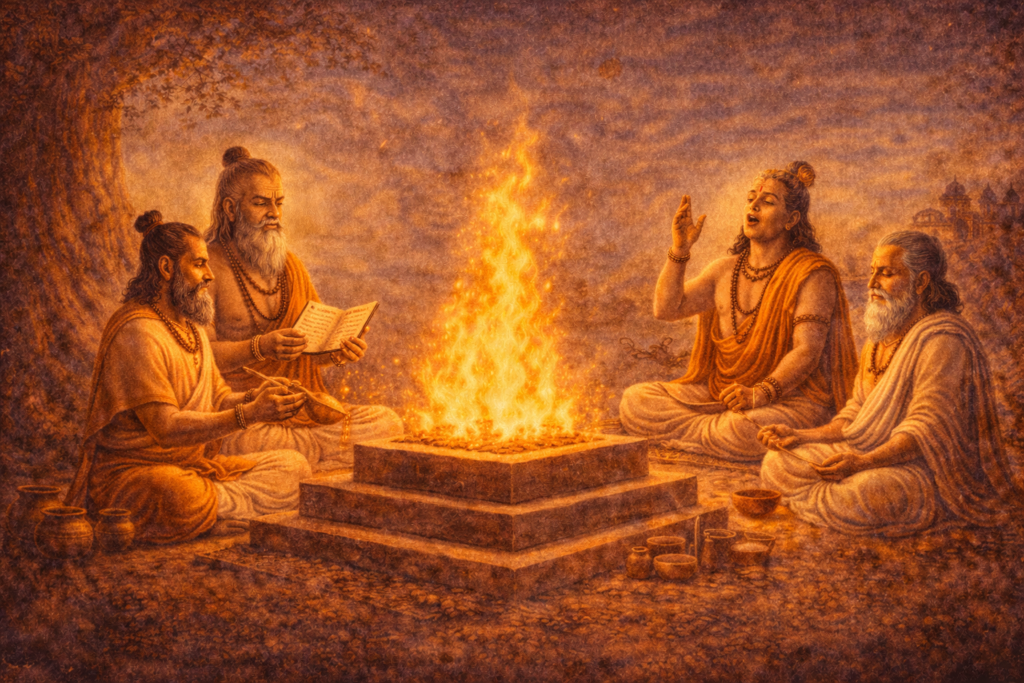
Udgātṛ’s Function
- Sings Sāmans exactly at Soma pressing
- Controls cosmic rhythm
- One wrong svara → ritual collapse
Udgātṛ is assisted by:
- Prastotṛ
- Pratihartṛ
- Subrahmaṇya
Sāmaveda singing is team-based yajña technology.
⑤ WHY STOBHAS EXIST (ESOTERIC + PRACTICAL)
Stobhas like hā, ho, ī, vā are NOT random.
Three reasons:
1️⃣ Breath Control
They regulate prāṇa flow.
2️⃣ Time Expansion
They stretch mantra to match cosmic time units (mātrā).
3️⃣ Non-verbal Power
They bypass intellect and act directly on vibration.
Meaning works on mind.
Sound works on reality.
That’s why stobhas are never translated.
⑥ SCIENTIFIC / ACOUSTIC EFFECTS (NO MYSTICISM, PURE MECHANICS)
Modern studies + Vedic insight agree:
A. Vagus Nerve Activation
- Long vowels
- Slow breath
- Monotone pitch
→ induces parasympathetic dominance
B. Brainwave Shift
- Chanting produces theta–alpha overlap
- Leads to deep focus, low thought activity
C. Resonance Zones
- Ma (4) → chest
- Pa (5) → throat
- Dha (6) → head cavity
Correct Sāmaveda singing creates a vertical resonance column.
FINAL NON-NEGOTIABLE RULES (RECAP)
❌ Do not mix traditions
❌ Do not add rāga
❌ Do not shorten vowels
❌ Do not sing emotionally
✅ Same pitch every time
✅ Silence after Nidhana
✅ Learn orally whenever possible
I. FULL SOMA-YAJÑA SEQUENCE
(Where Sāmaveda Actually Lives)
Sāmaveda does not exist independently. It comes alive only inside Soma-yajña.
1. The Moment of Singing
Sāmans are sung only at precise ritual moments, mainly during:
- Soma pressing (Abhiṣava)
- Soma offering (Havana)
The Udgātṛ sings exactly when Soma juice flows.
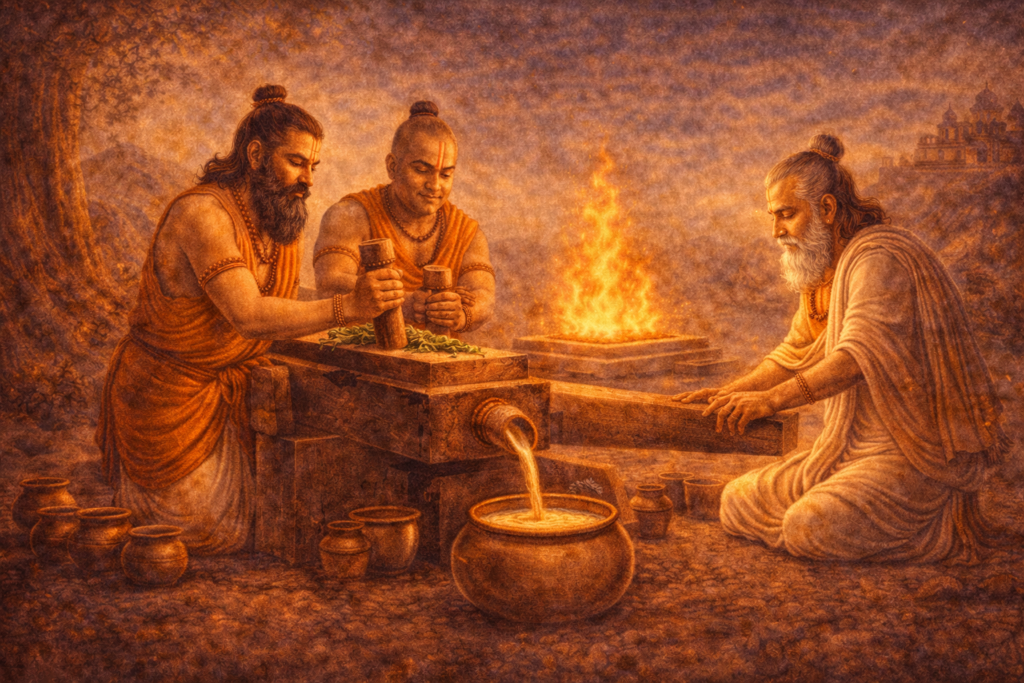
Sound + Liquid + Fire = Ritual engine
2. Sequence of a Single Sāman in Yajña
- Prastotṛ begins the Prastāva
- Udgātṛ sings the Udgītha
- Pratihartṛ responds with Pratihāra
- Udgātṛ continues Upadrava
- All settle in Nidhana
This is call–response–expansion–closure, not solo music.
One priest alone cannot perform Sāmaveda.
3. Why Timing Is Absolute
If a Sāman is sung:
- Early → energy leaks
- Late → ritual breaks
- Wrong pitch → symbolic injury to yajña
That is why Udgātṛ was the most feared priest in ancient India.
II. GĀNA, ĀRCHIKA, GRĀMA-GEYA, ARAṆYA-GEYA
(Four Forms of the Same Reality)
This is crucial. Most confusion comes from not knowing this.
1. Ārchika (Source Text)
- Closest to Ṛgveda
- Words intact
- Almost no stobhas
- Not sung in yajña
Used only to identify mantras.
2. Grāma-Geya (Village Singing)
- First musical form
- Short elongations
- Teaching stage
- Sung outside forest
This is where students start.
3. Araṇya-Geya (Forest Singing)
- Deeper
- Longer elongations
- More stobhas
- Sung in solitude
Used by advanced students and vānaprasthas.
4. Gāna (True Sāmaveda)
- Fully expanded
- Maximum elongation
- Ritual-grade
- Only form used in Soma-yajña
If you only know Gāna from books, you still don’t “know” Sāmaveda.
III. WHY SĀMAVEDA IS CALLED THE VEDA OF THE SUN
This is not poetic. It is literal.
1. Udgītha = Sun
From Chāndogya Upaniṣad:
Udgītho vai ādityaḥ
“Udgītha is the Sun”
Why?
- Sun regulates time
- Udgītha regulates ritual time
- Both rise, expand, settle
The svara movement 4 → 5 → 6 → 5 → 4 mirrors the solar arc.
2. Solar Physiology
Correct Sāmaveda singing:
- Activates diaphragm
- Expands chest
- Lifts sound to head
This mirrors prāṇa rising with the sun.
That is why Sāmans are never sung casually at night.
IV. DAILY SĀDHANA FOR HOUSEHOLDERS
(Without Soma-yajña)
Even without yajña, discipline is mandatory.
Ideal Daily Practice (40 Minutes)
1. Preparation (5 min)
- Bath or face wash
- East-facing seat
- Silence
2. Svara Stabilization (10 min)
Chant only:
4 — 5 — 4
Ma — Pa — Ma
No words.
3. Stobha Practice (10 min)
hāāā — hooo — īīī
Long breath, no tension.
4. One Complete Sāman (10 min)
Exactly one.Never more.
5. Silence (5 min)
Sit absolutely still.
This silence is non-optional.
V. WHY EMOTION IS FORBIDDEN IN SĀMAVEDA
This is subtle but essential.
- Emotion = personal fluctuation
- Sāmaveda = cosmic constancy
Emotion distorts pitch.
That is why:
- No bhāva
- No tears
- No devotion display
True devotion here is obedience to sound.
VI. FINAL INNER MEANING
Sāmaveda teaches one truth:
Reality responds to vibration, not intention
- Ṛgveda → meaning
- Yajurveda → action
- Sāmaveda → transformation
That is why the Upaniṣads emerge from Sāmaveda, not from music.
SĀMAVEDA STUDENT WORKBOOK
Discipline, Practice, and Correction
(For serious learners following a living or intended guru–śiṣya path)
How to Use This Workbook
This workbook is not a textbook.
It is a practice companion.
You should:
- write in it
- mark errors
- return to earlier sections repeatedly
- never “finish” it
Progress in Sāmaveda is circular, not linear.
SECTION 1: FOUNDATIONAL DISCIPLINE CHECKLIST
Before every practice session, confirm the following.
Physical Discipline
☐ Body clean
☐ Spine upright but relaxed
☐ Jaw, throat, shoulders loose
☐ No physical fatigue
Mental Discipline
☐ No emotional agitation
☐ No urgency or hurry
☐ No intention to “sound good”
Environmental Discipline
☐ Quiet space
☐ No audience
☐ Same place, same time (whenever possible)
If any box is unchecked, do not proceed.
SECTION 2: SVARA STABILITY PRACTICE (PRE-MANTRA)
Daily Requirement
- Duration: 10 minutes
- Content: Svaras only
- No words
- No stobhas
Self-Assessment (circle one)
- Pitch stable: YES / NO
- Breath steady: YES / NO
- Any sliding between notes: YES / NO
If NO appears anywhere → Do not attempt Sāman practice that day.
SECTION 3: STOBHA DISCIPLINE
Practice Rules
- Only traditional stobhas
- Full elongation
- No rhythmic play
Common Errors
☐ Shortening vowels
☐ Adding emotion
☐ Treating stobha as lyric
Correction Note (Guru / Self):
______________________________________________________
______________________________________________________
SECTION 4: SINGLE SĀMAN PRACTICE LOG
Rule: One Sāman per session. Never more.
Practice Entry (Fill daily)
Date: __________
Time: __________
Tradition: Kauthuma / Jaiminīya (circle one)
Observations:
- Breath broke? YES / NO
- Pitch drift? YES / NO
- Silence after Nidhana held? YES / NO
If silence was not held, the practice is invalid.
SECTION 5: SILENCE OBSERVATION (MOST IMPORTANT)
After completing the Sāman:
- Duration of silence held: ______ seconds
- Mind state during silence:
- ☐ Still
- ☐ Restless
- ☐ Dull
- ☐ Clear
Instruction
If silence feels forced, return to svara practice.
If silence feels natural, do not increase practice quantity.
SECTION 6: ERROR TAXONOMY (DO NOT IGNORE)
Technical Errors
☐ Pitch sliding
☐ Inconsistent elongation
☐ Breath collapse
Conceptual Errors
☐ Thinking about meaning
☐ Seeking emotional experience
☐ Comparing with music
Behavioral Errors
☐ Over-practicing
☐ Skipping silence
☐ Mixing traditions
Any repeated error = stop progression.
SECTION 7: GURU CORRECTION RECORD
Gurus often correct without explanation.
This section is to record, not analyze.
Date: __________
Correction observed (sound / gesture / repetition):
______________________________________________________
______________________________________________________
Student response:
______________________________________________________
SECTION 8: WEEKLY REVIEW (ONCE ONLY)
At the end of each week, answer honestly.
- Did pitch stability improve? YES / NO
- Did silence lengthen naturally? YES / NO
- Did effort reduce? YES / NO
If NO to all three → repeat same week again.
SECTION 9: NON-NEGOTIABLE RULES
- Do not chase progress
- Do not increase quantity
- Do not explain Sāmaveda to others casually
- Do not practice when emotionally disturbed
- Do not continue without silence
Correct practice leaves nothing to be added.
ॐ
ಧ್ವನಿ, ಯಜ್ಞ, ಮತ್ತು ಮೌನ
ಪರಿಚಯ: ಸಾಮವೇದ ಸಂಗೀತವಲ್ಲ ಏಕೆ ?
ನಾಲ್ಕು ವೇದಗಳಲ್ಲಿ ಸಾಮವೇದವು ಬಹುಮಟ್ಟಿಗೆ ತಪ್ಪಾಗಿ ಅರ್ಥಮಾಡಿಕೊಳ್ಳಲ್ಪಡುವ ಸ್ಥಾನವನ್ನು ಹೊಂದಿದೆ. ಇದನ್ನು ಸಾಮಾನ್ಯವಾಗಿ ತಪ್ಪಾಗಿ – “ಸಂಗೀತದ ವೇದ” ಎಂದು ಕರೆಯಲಾಗುತ್ತದೆ. ಈ ತಪ್ಪು ಅಭಿಪ್ರಾಯವು ಅದರ ಗಾಯನ ರೂಪಗಳು ನಂತರದ ಭಾರತೀಯ ಸಂಗೀತ ಪರಂಪರೆಯೊಂದಿಗೆ ಹೊಂದಿರುವ ಮೇಲ್ಮೈ ಸಾಮ್ಯದಿಂದ ಹುಟ್ಟಿದೆ. ವಾಸ್ತವದಲ್ಲಿ ಸಾಮವೇದ ಸಂಗೀತವಲ್ಲ. ಅದು ಸೌಂದರ್ಯಾನುಭವ, ಭಾವಪ್ರಕಟಣೆ ಅಥವಾ ಕಲಾತ್ಮಕ ಸುಧಾರಣೆಗಾಗಿ ರೂಪಿಸಲ್ಪಟ್ಟದ್ದಲ್ಲ. ಸಾಮವೇದವು ಶುದ್ಧ ಯಜ್ಞಧ್ವನಿ ವಿಜ್ಞಾನ. ಒಂದು ಉದ್ದೇಶಕ್ಕಾಗಿ ಮಾತ್ರ ರೂಪಿತವಾದ ವ್ಯವಸ್ಥೆ— ಸೋಮಯಜ್ಞದ ಸಮರ್ಪಕ ನಿರ್ವಹಣೆ.
ಋಗ್ವೇದದಲ್ಲಿ ದೇವತೆಗಳನ್ನು ಅರ್ಥಪೂರ್ಣ ಸೂಕ್ತಗಳ ಮೂಲಕ ಆಹ್ವಾನಿಸಲಾಗುತ್ತದೆ ಯಜುರ್ವೇದದಲ್ಲಿ ಯಜ್ಞವು ನಿಖರ ಕ್ರಿಯೆಗಳ ಮೂಲಕ ಕಾರ್ಯರೂಪ ಪಡೆಯುತ್ತದೆ. ಆದರೆ ಸಾಮವೇದದಲ್ಲಿ ಧ್ವನಿಯೇ ಸ್ವತಃ ಯಜ್ಞೋಪಕರಣವಾಗುತ್ತದೆ. ಇಲ್ಲಿ ಅರ್ಥವು ದ್ವಿತೀಯವಾಗುತ್ತದೆ — ಅನೇಕ ಸಂದರ್ಭಗಳಲ್ಲಿ ಸಂಪೂರ್ಣವಾಗಿ ಅಪ್ರಸ್ತುತವೂ ಆಗುತ್ತದೆ. ಮುಖ್ಯವಾಗಿರುವುದು ಸ್ವರ, ಕಾಲಾವಧಿ, ಕ್ರಮ, ಉಸಿರಾಟ ಮತ್ತು ಮೌನ. ತಪ್ಪಾದ ಸ್ವರದೊಂದಿಗೆ ಗಾಯನಗೊಂಡ ಮಂತ್ರ “ಕಡಿಮೆ ಪರಿಣಾಮಕಾರಿ” ಎನ್ನಲಾಗುವುದಿಲ್ಲ. ಅದನ್ನು ಯಜ್ಞದ ದೃಷ್ಟಿಯಿಂದ ಅಮಾನ್ಯ ಎಂದು ಪರಿಗಣಿಸಲಾಗುತ್ತದೆ.
ಅರ್ಥದಿಂದ ಕಂಪನದ ಕಡೆಗೆ ನಡೆಯುವ ಈ ಮೂಲಭೂತ ಪರಿವರ್ತನೆಯೇ ಸಾಮವೇದವನ್ನು ವೈದಿಕ ಚಿಂತನೆಯೊಳಗಿನ ವಿಭಿನ್ನ ಜ್ಞಾನವ್ಯವಸ್ಥೆಯಾಗಿ ಸ್ಥಾಪಿಸುತ್ತದೆ. ಸಾಮವೇದವನ್ನು ಗ್ರಹಿಸಲು, ಸಂಗೀತ, ಭಕ್ತಿ ಮತ್ತು ಪ್ರದರ್ಶನಗಳ ಕುರಿತ ಆಧುನಿಕ ಊಹೆಗಳನ್ನು ತಾತ್ಕಾಲಿಕವಾಗಿ ಬದಿಗೊತ್ತಿ, ಧ್ವನಿಯೇ ಕಾಲ, ಉಸಿರು ಮತ್ತು ಋತವನ್ನು ನಿಯಂತ್ರಿಸುವ ವಿಶ್ವದೃಷ್ಟಿಗೆ ಪ್ರವೇಶಿಸಬೇಕು.
ಸಾಮವೇದದಲ್ಲಿ ಧ್ವನಿಯ ತಾತ್ತ್ವಿಕ ಸ್ಥಾನ
ಸಾಮವೇದದಲ್ಲಿ ಧ್ವನಿ ಅರ್ಥವನ್ನು ಹೊತ್ತೊಯ್ಯುವ ಮಾಧ್ಯಮವಲ್ಲ. ಅದು ಕ್ರಿಯೆಯ ಸ್ವರೂಪ. ಬ್ರಾಹ್ಮಣ ಗ್ರಂಥಗಳು ಪುನಃಪುನಃ ಒತ್ತಿಹೇಳುವ ಸಂಗತಿ ಏನೆಂದರೆ — ಯಜ್ಞವು ಸಂಕಲ್ಪದಿಂದಲೋ ನಂಬಿಕೆಯಿಂದಲೋ ಯಶಸ್ವಿಯಾಗುವುದಿಲ್ಲ. ಅದು ಸರಿಯಾದ ನಿರ್ವಹಣೆಯಿಂದಲೇ ಸಿದ್ಧಿಸುತ್ತದೆ. ಸರಿಯಾಗಿ ಉತ್ಪಾದಿಸಲ್ಪಟ್ಟ ಧ್ವನಿಯು ಯಜ್ಞಕ್ಷೇತ್ರದ ಮೇಲೆ ನೇರವಾಗಿ ಕಾರ್ಯನಿರ್ವಹಿಸುತ್ತದೆ.
ಈ ಕಾರಣಕ್ಕೇ ಸಾಮವೇದದ ಹೆಚ್ಚಿನ ಮಂತ್ರಗಳು ಋಗ್ವೇದದಿಂದ ತೆಗೆದುಕೊಳ್ಳಲ್ಪಟ್ಟಿವೆ. ಋಗ್ವೇದೀಯ ಸೂಕ್ತವು ಶಬ್ದಾಧಾರವನ್ನು ಒದಗಿಸುತ್ತದೆ. ಆದರೆ ಸಾಮವೇದದಲ್ಲಿ ಸೇರಿದ ಕ್ಷಣದಿಂದ ಮಂತ್ರವು ಮಾತಾಗಿ ಉಳಿಯುವುದಿಲ್ಲ. ಅದನ್ನು ವಿಸ್ತರಿಸಲಾಗುತ್ತದೆ, ವಿಭಜನೆಯಾಗುತ್ತದೆ, ಪುನರಾವರ್ತನೆಯಾಗುತ್ತದೆ ಮತ್ತು ವ್ಯಾಖ್ಯಾನಿಸಲಾಗದ (ಅರ್ಥರಹಿತ ?) ಅಕ್ಷರಗಳು (ಸ್ತೋಭಗಳು) ಜೊತೆಗೆ ಹೆಣೆದುಕೊಳ್ಳುತ್ತದೆ. ಈ ಪ್ರಕ್ರಿಯೆಯಲ್ಲಿ ಭಾಷೆ ವಿಸರ್ಜಿತವಾಗುತ್ತದೆ. ಧ್ವನಿ ಕಲ್ಪನೆಯ ಬಂಧನದಿಂದ ಮುಕ್ತವಾಗುತ್ತದೆ.
ಈ ತಾತ್ತ್ವಿಕ ಪರಿವರ್ತನೆ ಸ್ಪಷ್ಟವಾಗಿದೆ:
- ಋಗ್ವೇದದಲ್ಲಿ: ಮಂತ್ರ = ಅರ್ಥಪೂರ್ಣ ಉಚ್ಚಾರಣೆ
- ಸಾಮವೇದದಲ್ಲಿ: ಸಾಮ = ಕಂಪನಾತ್ಮಕ ರಚನೆ
ಆದ್ದರಿಂದಲೇ ಸಾಮವೇದವನ್ನು ಅರ್ಥಪೂರ್ಣವಾಗಿ “ಅನುವಾದ” ಮಾಡಲಾಗುವುದಿಲ್ಲ. ಅನುವಾದ ಅರ್ಥವನ್ನು ಉಳಿಸುತ್ತದೆ. ಸಾಮವೇದವು ಅರ್ಥದಾಚೆ ಕಾರ್ಯನಿರ್ವಹಿಸುತ್ತದೆ.
ಸಾಮವೇದ ಗಾಯನದ ಮೂಲ ತತ್ತ್ವ
ಸಾಮವೇದ = ಋಗ್ವೇದೀಯ ಮಂತ್ರ + ಸಂಗೀತಾತ್ಮಕ ಪರಿವರ್ತನೆ (ಸಾಮನ್)
- ಪದಗಳು ಹೆಚ್ಚಾಗಿ ಋಗ್ವೇದದಿಂದ ಬಂದಿವೆ
- ಆತ್ಮಸಾರವು ಸ್ವರಗಳಿಂದ (ಸಂಗೀತ ಸ್ವರಗಳು) ಉದ್ಭವಿಸುತ್ತದೆ
- ಅರ್ಥಕ್ಕಿಂತ ಸರಿಯಾದ ಧ್ವನಿಕಂಪನವೇ ಮುಖ್ಯ
- ತಪ್ಪು ಸ್ವರ ಬಳಕೆಯಾದರೆ ಮಂತ್ರ ಕಾರ್ಯಶೂನ್ಯವಾಗುತ್ತದೆ
ಅದಕ್ಕಾಗಿಯೇ ಸಾಮವೇದವನ್ನು ಪರಂಪರೆಯಂತೆ
ಗುರುಮುಖದಿಂದ ವಾಚಿಕವಾಗಿ ಮಾತ್ರ ಕಲಿಯಲಾಗುತ್ತದೆ.
ಯಜ್ಞ ತಂತ್ರಜ್ಞಾನವಾಗಿ ಧ್ವನಿ (ಬ್ರಾಹ್ಮಣ ಚೌಕಟ್ಟು)
ಪಂಚವಿಂಶ ಬ್ರಾಹ್ಮಣ (ತಾಂಡ್ಯ ಮಹಾಬ್ರಾಹ್ಮಣ)ವು ಸಾಮವೇದದ ಯಜ್ಞಪಾತ್ರವನ್ನು ಅತ್ಯಂತ ಕ್ರಮಬದ್ಧವಾಗಿ ವಿವರಿಸುತ್ತದೆ. ಪ್ಲುತಿ (ದೀರ್ಘೀಕರಣ), ಪುನರಾವರ್ತನೆ ಮತ್ತು ಧ್ವನಿ ವಿಭಾಗೀಕರಣಗಳ ಮೂಲಕ ಗಾಯನವು ಯಜ್ಞಕಾಲಘಟಕಗಳೊಂದಿಗೆ (ಮಾತ್ರೆಗಳು) ಹೇಗೆ ಹೊಂದಿಕೆಯಾಗುತ್ತದೆ ಎಂಬುದನ್ನು ಅದು ವಿವರಿಸುತ್ತದೆ. ಯಜ್ಞದಲ್ಲಿನ ಕಾಲವು ಘಡಿಯ ಕಾಲವಲ್ಲ. ಅದು ಧ್ವನಿಯಿಂದಲೇ ಸೃಜಿತವಾಗುತ್ತದೆ ಮತ್ತು ನಿರ್ವಹಿತವಾಗುತ್ತದೆ.
ಸರಿಯಾಗಿ ಗಾಯನಗೊಂಡ ಸಾಮ ಒಂದು ಚಿಕ್ಕ ಋಗ್ವೇದೀಯ ಮಂತ್ರವನ್ನು ದೀರ್ಘ ಕಾಲವ್ಯಾಪ್ತಿಗೆ ವಿಸ್ತರಿಸುತ್ತದೆ. ಈ ಕಾಲವಿಸ್ತಾರವೇ ಸೋಮರಸ, ಹೋಮಾದಿ ಕ್ರಿಯೆಗಳನ್ನು ಬ್ರಹ್ಮಾಂಡೀಯ ಲಯಗಳೊಂದಿಗೆ ಹೊಂದಾಣಿಕೆಗೊಳಿಸುತ್ತದೆ. ಗಾಯನವು ಯಜ್ಞವನ್ನು ಅನುಸರಿಸುವುದಿಲ್ಲ,ಅದು ಯಜ್ಞವನ್ನು ನಿಯಂತ್ರಿಸುತ್ತದೆ.
ಬ್ರಾಹ್ಮಣ ಗ್ರಂಥಗಳು ಈ ವಿಷಯದಲ್ಲಿ ರಾಜಿಯಾಗುವುದಿಲ್ಲ
- ಶೀಘ್ರ ಗಾಯನ → ಶಕ್ತಿಯ ಚ್ಯುತಿ
- ವಿಳಂಬ ಗಾಯನ → ಯಜ್ಞಭಂಗ
- ತಪ್ಪು ಸ್ವರ → ಯಜ್ಞಕ್ಕೆ ಸಂಕೇತಾತ್ಮಕ ಹಾನಿ
ಆದ್ದರಿಂದ ಉದ್ಗಾತೃನ ಹೊಣೆಗಾರಿಕೆ ಅಪಾರ. ಅವನ ಕರ್ತವ್ಯ ಕಲಾತ್ಮಕ ಪ್ರದರ್ಶನವಲ್ಲ, ಅದು ಕಾಲನಿಯಂತ್ರಣ.
ಶಿಕ್ಷಾಮತ್ತು ಗುರು – ಶಿಷ್ಯ ಪರಂಪರೆಯ ಅನಿವಾರ್ಯತೆ
ಸಾಮವೇದವು ಸಂಪೂರ್ಣವಾಗಿ ಗುರುಶಿಷ್ಯ ಪರಂಪರೆಯ ಮೂಲಕವೇ ಉಳಿದುಕೊಂಡಿದೆ. ಇದು ಸಂಸ್ಕೃತಿಕ ಸಂರಕ್ಷಣಾವಾದವಲ್ಲ, ಇದು ಕಾರ್ಯಾತ್ಮಕ ಅವಶ್ಯಕತೆ. ಲಿಖಿತ ಸಂಕೇತಗಳು ಕೆಳಗಿನವುಗಳನ್ನು ದಾಖಲಿಸಲು ಅಸಮರ್ಥ
- ಸ್ವರದ ಸೂಕ್ಷ್ಮ ಸ್ಥಿರತೆ
- ದೀರ್ಘೀಕರಣದೊಳಗಿನ ಉಸಿರಾಟದ ನಿರಂತರತೆ
- ಸ್ವರದ ದೇಹಸ್ಮೃತಿ
ಸಾಮವೇದೀಯ ಕಲಿಕೆ – ಅಧ್ಯಯನದಲ್ಲಿ ದೇಹವೇ ವಾದ್ಯ. ಶಿಷ್ಯನಿಗೆ ಎದೆ ಸ್ಥಿರಪಡಿಸುವುದು, ಉಸಿರಾಟ ನಿಯಂತ್ರಿಸುವುದು ಮತ್ತು ಕಂಪನವಿಲ್ಲದೆ ಸ್ವರ ಹಿಡಿಯುವ ತರಬೇತಿ ನೀಡಲಾಗುತ್ತದೆ. ಭಾವನಾತ್ಮಕ ಏರುಪೇರುಗಳನ್ನು ಸ್ಪಷ್ಟವಾಗಿ ತಡೆಹಿಡಿಯಲಾಗುತ್ತದೆ, ಏಕೆಂದರೆ ಅವು ಸ್ವರವನ್ನು ಅಸ್ಥಿರಗೊಳಿಸುತ್ತವೆ.
ಬೇರೆಡೆ ಸಂಗೀತಾತ್ಮಕವಾಗಿ ಸ್ವೀಕಾರಾರ್ಹವಾಗಬಹುದಾದ ವ್ಯತ್ಯಾಸ ಇಲ್ಲಿ ದೋಷ (ದೋಷ) ಎಂದು ಪರಿಗಣಿಸಲಾಗುತ್ತದೆ. ಆದ್ದರಿಂದಲೇ ಗುರುಗಳು ವಿವರಣೆ ನೀಡದೆ ಸರಿಯಾಗಿ ಮರುಗಾಯನ ಮಾಡುವ ಮೂಲಕ ಶಿಷ್ಯನ ದೇಹವನ್ನು ತಿದ್ದುತ್ತಾರೆ.
ಅರ್ಹತೆ ಮತ್ತು ಆಂತರಿಕ ಸಿದ್ಧತೆ (ಅಧಿಕಾರ)
ಸಾಮವೇದ ಗಾಯನಕ್ಕೆ ಮೊದಲು ಪರಂಪರೆಯಂತೆ ಕೆಳಗಿನವು ಅಗತ್ಯ
- ದೈಹಿಕ ಮತ್ತು ಮಾನಸಿಕ ಶುದ್ಧತೆ
- ಸ್ನಾನ ಮಾಡಿರಬೇಕು
- ಪೂರ್ವ ಅಥವಾ ಉತ್ತರ ದಿಕ್ಕಿಗೆ ಮುಖ ಮಾಡಿ ಕುಳಿತುಕೊಳ್ಳಬೇಕು
- ಆಚಮನ ಮಾಡಬೇಕು
- ಮೌನ ಮತ್ತು ಏಕಾಗ್ರತೆ ಕಾಪಾಡಬೇಕು
ಸಾಮವೇದ ಗಾಯನವು ಪ್ರದರ್ಶನಕೇಂದ್ರಿತವಲ್ಲ, ಅದು ಯಜ್ಞಕೇಂದ್ರಿತ.
ಸಾಮವೇದದ ಮೂಲ ಸಂಗೀತ ವ್ಯವಸ್ಥೆ
🎵 ಸಾಮವೇದದಲ್ಲಿ ೭ ಸ್ವರಗಳಿವೆ
| ಸಾಮವೇದ ಹೆಸರು | ಆಧುನಿಕ ಸಮೀಪದ ಸ್ವರ |
| ಪ್ರಥಮ | ಸ |
| ದ್ವಿತೀಯ | ರಿ |
| ತೃತೀಯ | ಗ |
| ಚತುರ್ಥ | ಮ |
| ಪಂಚಮ | ಪ |
| ಷಷ್ಠ | ಧ |
| ಸಪ್ತಮ | ನಿ |
⚠️ ಇವು ಕರ್ನಾಟಿಕ ಅಥವಾ ಹಿಂದುಸ್ತಾನಿ ಸಂಗೀತದ ಸ್ವರಗಳಿಗೆ ಸರಿಹೊಂದುವುದಿಲ್ಲ
ಸಾಮವೇದ ಸ್ವರಗಳು ರಾಗಾಧಾರಿತ ಸಂಗೀತವಲ್ಲ, ಅವು ಯಜ್ಞಧ್ವನಿಗಳು.
ಸಾಮವೇದ ಗಾಯನದ ಮುಖ್ಯ ಲಕ್ಷಣಗಳು
1️⃣ ದೀರ್ಘೀಕರಣ (ಪ್ಲುತ)
ಸ್ವರಗಳು ದೀರ್ಘವಾಗಿ ಎಳೆಯಲ್ಪಡುತ್ತವೆ.
ಉದಾಹರಣೆ:
ಅಗ್ನಿಂ ಈಳೇ ಪುರೋಹಿತಂ
↓
ಆಆಆ-ಗ್ನೀಈಈಈಂ ಈಈಈ-ಳೇಏಏಏ
2️⃣ ಪುನರಾವರ್ತನೆ (ಅಭ್ಯಾಸ)
- ಪದಗಳು ಪುನರಾವರ್ತಿತವಾಗುತ್ತವೆ
- ಕೆಲವೊಮ್ಮೆ ಅಕ್ಷರಗಳು ವಿಭಜಿಸಲ್ಪಡುತ್ತವೆ
3️⃣ ಸ್ತೋಭಗಳ ಸೇರ್ಪಡೆ
ಸ್ತೋಭ = ವ್ಯಾಖ್ಯಾನರಹಿತ ಧ್ವನಿಪೂರಕ ಅಕ್ಷರಗಳು
ಸಾಮಾನ್ಯ ಸ್ತೋಭಗಳು:
- ಹಾ
- ಹೋ
- ಹು
- ವಾ
- ಓ
- ಈ
ಉದಾಹರಣೆ:
ಅಗ್ನಾಯಿ → ಹಾ ಅಗ್ನಾಯಿ ಹೋ
⚠️ ಸ್ತೋಭಗಳಿಗೆ ವ್ಯಾಖ್ಯಾನವಿಲ್ಲ, ಅವುಗಳ ಕಾರ್ಯ ಸಂಗೀತಾತ್ಮಕ ಮತ್ತು ಯಜ್ಞಾತ್ಮಕ ಮಾತ್ರ.
ಸಾಮದ ಆಂತರಿಕ ವಿನ್ಯಾಸ
ಪ್ರತಿ ಸಾಮವು ಕಡ್ಡಾಯವಾಗಿ ಐದು ಭಾಗಗಳ ರಚನೆಯನ್ನು ಅನುಸರಿಸುತ್ತದೆ:
- ಪ್ರಸ್ತಾವ – ಸ್ತೋಭಗಳ ಮೂಲಕ ಆರಂಭ
- ಉದ್ಗೀಥ – ಮುಖ್ಯ ಧ್ವನಿಕಾಯ
- ಪ್ರತಿಹಾರ – ಪ್ರತಿಕ್ರಿಯೆ ಮತ್ತು ಸ್ಥಿರೀಕರಣ
- ಉಪದ್ರವ – ವಿಸ್ತಾರ ಮತ್ತು ಪೂರ್ಣತೆ
- ನಿಧನ – ಮೌನದಲ್ಲಿ ಲಯ
ಇದು ಶೈಲಿಯ ಆಯ್ಕೆಯಲ್ಲ. ಇದು ಯಜ್ಞವಿಧಿಯ ನಿಯಮ. ಅತ್ಯಂತ ತಪ್ಪಾಗಿ ಅರ್ಥೈಸಲ್ಪಡುವ ಅಂಶ ನಿಧನ. ಸಾಮಾನ್ಯ ಓದುಗರು ಗಾಯನವು ಧ್ವನಿಯಲ್ಲಿ ಅಂತ್ಯಗೊಳ್ಳುತ್ತದೆ ಎಂದು ಭಾವಿಸುತ್ತಾರೆ. ಸಾಮವೇದದಲ್ಲಿ ಅದು ತಪ್ಪು.
ಗಾಯನವು ಮೌನದಲ್ಲಿ ಅಂತ್ಯಗೊಳ್ಳುತ್ತದೆ.
ನಿಧನದ ನಂತರ ಮಾತನಾಡುವುದು, ಚಲಿಸುವುದು ಅಥವಾ ತಕ್ಷಣ ಮುಂದುವರಿಯುವುದು ದೋಷವೆಂದು ಪರಿಗಣಿಸಲಾಗುತ್ತದೆ, ಏಕೆಂದರೆ ಮೌನವೂ ಕೊನೆಯ ಅರ್ಪಣೆಯೇ.
ಸ್ತೋಭಗಳು ಮತ್ತು ಅರ್ಥಬಂಧನದಿಂದ ಧ್ವನಿಯ ವಿಮೋಚನೆ
ಹಾ, ಹೋ, ಈ, ವಾ ಮುಂತಾದ ಸ್ತೋಭಗಳನ್ನು ಅರ್ಥರಹಿತ ತುಂಬಿಕೆ ಎಂದು ತಳ್ಳಿಹಾಕುವುದು ಭಾರೀ ತಪ್ಪು. ಸ್ತೋಭಗಳು ಮೂರು ಪ್ರಮುಖ ಕಾರ್ಯಗಳನ್ನು ನಿರ್ವಹಿಸುತ್ತವೆ:
- ಉಸಿರಾಟ ನಿಯಂತ್ರಣೆ
- ಯಜ್ಞಕಾಲ ವಿಸ್ತರಣೆ
- ಧ್ವನಿಯನ್ನು ಭಾಷೆಯಿಂದ ವಿಚ್ಛೇದಿಸುವುದು
ಜೈಮಿನೀಯ ಬ್ರಾಹ್ಮಣವು ಸ್ತೋಭಗಳನ್ನು ಪದಗಳಾಗಿ ಅಲ್ಲ, ಪ್ರಾಣವಾಹಕರಾಗಿ ವಿವರಿಸುತ್ತದೆ. ಅರ್ಥವನ್ನು ತೆಗೆದುಹಾಕುವುದರಿಂದ ಗಾಯನವು ಬುದ್ಧಿಯನ್ನು ಬಿಟ್ಟು ದೇಹಶಾಸ್ತ್ರೀಯ ಮತ್ತು ಯಜ್ಞಾತ್ಮಕ ಪ್ರಕ್ರಿಯೆಗಳ ಮೇಲೆ ನೇರವಾಗಿ ಕಾರ್ಯನಿರ್ವಹಿಸುತ್ತದೆ.
ಆದ್ದರಿಂದಲೇ ಸ್ತೋಭಗಳನ್ನು ಎಂದಿಗೂ ಅನುವಾದಿಸಬಾರದು, ಬದಲಾಯಿಸಬಾರದು ಅಥವಾ ಬದಲಿಸಬಾರದು.
ಮುಖ್ಯ ಗಾಯನ ಶೈಲಿಗಳು (ಪಾಠಗಳು)
1️⃣ ಗಾನ (ಗಾಯನ ರೂಪ) — ನಿಜವಾದ ಸಾಮವೇದ
- ಸೋಮಯಜ್ಞದಲ್ಲಿ ಉಪಯೋಗವಾಗುತ್ತದೆ
- ಸಂಪೂರ್ಣವಾಗಿ ಸಂಗೀತಾತ್ಮಕ
- ದೀರ್ಘ ದೀರ್ಘೀಕರಣ ಹೊಂದಿದೆ
- ಸ್ತೋಭಗಳ ಬಳಕೆ ಇರುತ್ತದೆ
2️⃣ ಆರ್ಚಿಕ / ಗ್ರಾಮಗೇಯ / ಅರಣ್ಯಗೇಯ
- ಮಧ್ಯಂತರ ರೂಪಗಳು
- ಕಲಿಕೆಯ ಉದ್ದೇಶಕ್ಕಾಗಿ ಉಪಯೋಗಿಸಲಾಗುತ್ತವೆ
ಉದ್ಗೀಥ ಮತ್ತು ಸೌರತತ್ತ್ವ
ಛಾಂದೋಗ್ಯ ಉಪನಿಷತ್ತು ಹೇಳುತ್ತದೆ:
“ಉದ್ಗೀಥೋ ವೈ ಆದಿತ್ಯಃ”
(ಉದ್ಗೀಥವೇ ಸೂರ್ಯ)
ಇದು ರೂಪಕವಲ್ಲ. ಸಾಮನಿನ ಸ್ವರಚಲನೆ — ಏರಿಕೆ, ಸ್ಥಿರತೆ, ಇಳಿಕೆ — ಸೂರ್ಯನ ಗತಿಯನ್ನೇ ಪ್ರತಿಬಿಂಬಿಸುತ್ತದೆ. ಸೂರ್ಯ ಬ್ರಹ್ಮಾಂಡಕಾಲವನ್ನು ನಿಯಂತ್ರಿಸುವಂತೆ, ಉದ್ಗೀಥ ಯಜ್ಞಕಾಲವನ್ನು ನಿಯಂತ್ರಿಸುತ್ತದೆ.
ಇದಕ್ಕಾಗಿಯೇ ಸಾಮವೇದ ಗಾಯನವು ಸಾಮಾನ್ಯವಾಗಿ ಹಗಲು ಯಜ್ಞಸಂದರ್ಭಗಳಿಗೆ ಹೊಂದಿಸಲಾಗುತ್ತದೆ. ಅದನ್ನು ಸ್ವೈಚ್ಛಿಕ ಭಕ್ತಿಗೀತೆಯಾಗಿ ಪರಿಗಣಿಸುವುದಿಲ್ಲ.
ಬಾಹ್ಯ ಯಜ್ಞದಿಂದ ಆಂತರಿಕ ಉಪಾಸನೆಗೆ
ಉಪನಿಷತ್ತುಗಳು ಸಾಮವೇದವನ್ನು ತಿರಸ್ಕರಿಸುವುದಿಲ್ಲ. ಅವು ಅದನ್ನು ಆಂತರೀಕರಿಸುತ್ತವೆ. ಬಾಹ್ಯ ಸೋಮಯಜ್ಞವು ಆಂತರಿಕ ಸಾಧನೆಯಾಗಿ ಪರಿವರ್ತಿತವಾಗುತ್ತದೆ. ಉದ್ಗೀಥ ಓಂಕಾರವಾಗುತ್ತದೆ. ಯಜ್ಞಉಸಿರು ಧ್ಯಾನಉಸಿರಾಗುತ್ತದೆ.
ಪ್ರಸಿದ್ಧ ವಿಧಿ:
“ಓಂ ಇತಿ ಉದ್ಗೀಥಮ್ ಉಪಾಸೀತ”
(ಓಂಕಾರವನ್ನು ಉದ್ಗೀಥವಾಗಿ ಉಪಾಸಿಸು)
ಸಾಮವೇದೀಯ ರಚನೆಯನ್ನು ಉಳಿಸಿಕೊಂಡು, ಅದು ಅಂತರ್ಗತವಾಗುತ್ತದೆ. ಧ್ವನಿ ಇನ್ನೂ ಮೌನದಲ್ಲಿ ಲಯಗೊಳ್ಳುತ್ತದೆ, ಯಜ್ಞವೇದಿಕೆ ಮಾತ್ರ ಒಳಗೆ ಸರಿಯುತ್ತದೆ.
ಮೌನ: ಅಪೂರ್ಣತೆಅಲ್ಲ, ಪರಿಪೂರ್ಣತೆ
ಆಧುನಿಕ ಚಿಂತನೆಗಳಲ್ಲಿ ಮೌನವೆಂದರೆ ಅಭಾವ, ಅಪೂರ್ಣತ. ಸಾಮವೇದದಲ್ಲಿ ಮೌನವೆಂದರೆ ಪರಿಪೂರ್ಣತೆ. ಗಾಯನದ ಗುರಿ ಧ್ವನಿಯನ್ನು ನಿರಂತರವಾಗಿ ಉತ್ಪಾದಿಸುವುದಲ್ಲ, ಧ್ವನಿಯ ಮೂಲಕ ನಿಶ್ಚಲತೆ ತಲುಪುವುದು.
ಇದೇ ಸಾಮವೇದದ ತಾತ್ತ್ವಿಕ ಶಿಖರ. ಉಪನಿಷತ್ತಿನ ಆಂತರಿಕ ಸಾಧನೆ ಸಾಮವೇದದಿಂದ ಸಹಜವಾಗಿ ಹೊರಹೊಮ್ಮುವುದಕ್ಕೆ ಇದುವೇ ಕಾರಣ.
ಪರಂಪರೆಗಳು, ಕುಸಿತ ಮತ್ತು ಉಳಿವು
ಇಂದು ಉಳಿದಿರುವ ಸಾಮವೇದೀಯ ಪರಂಪರೆಗಳು ಎರಡು:
- ಕೌಥುಮ – ರಾಣಾಯನೀಯ
- ಜೈಮಿನೀಯ
ಇವು ಸ್ವತಂತ್ರ ಸ್ವರ ವ್ಯಾಕರಣಗಳನ್ನು ಹೊಂದಿವೆ, ಅವುಗಳನ್ನು ಎಂದಿಗೂ ಮಿಶ್ರಗೊಳಿಸಬಾರದು. ಸೋಮಯಜ್ಞದ ಕುಂಠಿತ, ಆಶ್ರಯದ ಕೊರತೆ ಮತ್ತು ಸಾಮವೇದವನ್ನು “ಸಂಗೀತ”ವೆಂದು ತಪ್ಪಾಗಿ ಗುರುತಿಸಿದ ಪರಿಣಾಮವಾಗಿ ಅನೇಕ ಪರಂಪರೆಗಳು ನಾಶವಾದವು. ಇಂದಿನ ಉಳಿದಿರುವ ಪರಂಪರೆಗಳು ಸೂಕ್ಷ್ಮ, ಸಣ್ಣ ವಲಯಗಳಲ್ಲಿ ಸಂಗ್ರಹ ದಾಖಲೆಗಳಂತೆ ಉಳಿದಿವೆ.
ಸಾಮವೇದ: ಪುನಃಸಮ್ಮೇಳನ
ಸಾಮವೇದವು ಭಾವನಾತ್ಮಕ ಭಕ್ತಿ, ತಾತ್ತ್ವಿಕ ವಾದ ಅಥವಾ ಮೋಕ್ಷವನ್ನು ನೇರ ಗುರಿಯಾಗಿ ಹೊಂದಿಲ್ಲ. ಅದರ ಕಾರ್ಯ ಇನ್ನಷ್ಟು ಸೂಕ್ಷ್ಮ ಮತ್ತು ಕ್ರಾಂತಿಕಾರಿ — ಮನುಕುಲದ ಆತ್ಮೋನ್ನತ್ತಿಗಾಗಿ ಪುನಃಸಮ್ಮೇಳನಗೊಳಿಸುವುದು.
ಸಮ್ಮೇಳನ ಪೂರ್ಣವಾದಾಗ, ಧ್ವನಿ ಸ್ವಾಭಾವಿಕವಾಗಿ ಮೌನದಲ್ಲಿ ಲಯಗೊಳ್ಳುತ್ತದೆ.
ಆ ಮೌನ ಶೂನ್ಯವಲ್ಲ.ಅದು ನಿಖರತೆ.
ಒಂದು ಋಕ್ ಮಂತ್ರ ಹೇಗೆ ಸಾಮನಾಗುತ್ತದೆ
ಋಗ್ವೇದೀಯ ಮಂತ್ರ:
ಅಗ್ನಿಂ ಈಳೇ ಪುರೋಹಿತಂ
ಸಾಮವೇದ ರೂಪ (ಸರಳೀಕೃತ ಉದಾಹರಣೆ):
ಹಾ ಆಆಆಗ್ನೀಈಈಈಂ ಹೋ ಈಈಳೇಏಏಏ
ಪುರೋಓಓಓ ಹಿತಾಂ
➡️ ಇದು ಸ್ವೈಚ್ಛಿಕ ಗಾಯನವಲ್ಲ — ಪ್ರತಿ ಏರಿಕೆ ಮತ್ತು ಇಳಿಕೆಯೂ ನಿಶ್ಚಿತ ನಿಯಮಗಳು ವಿಧಿಸಲ್ಪಟ್ಟಿರುತ್ತದೆ.
ನಿಯಮಗಳು (ಅತ್ಯಂತ ಮಹತ್ವದವು)
❌ ತಾತ್ಕಾಲಿಕ ಕಲ್ಪನೆ (ಇಂಪ್ರೊವೈಸೇಶನ್) ಬೇಡ
❌ ರಾಗ ಕಲ್ಪನೆ ಬೇಡ
❌ ಭಾವನಾತ್ಮಕ ಅಭಿವ್ಯಕ್ತಿ ಬೇಡ
❌ ಗಾಯನದ ವೇಗದಲ್ಲಿ ಬದಲಾವಣೆ ಬೇಡ
✅ ಸಂಪೂರ್ಣ ಸ್ವರ ನಿಯಂತ್ರಣ
✅ ಗುರು–ಪರಂಪರೆ ಅನುಸರಣೆ
✅ ಉಸಿರಾಟ ಶಿಸ್ತು
✅ ಸ್ವರ ಶುದ್ಧತೆ
ಸಾಮವೇದವನ್ನು ಯಾಕೆ ಹಾಡಲಾಗುತ್ತದೆ? (ತತ್ತ್ವ)
- ಭಾರತೀಯ ಸಂಗೀತದ ಮೂಲವೆಂದು ಪರಿಗಣಿಸಲಾಗಿದೆ
- ಗಾಯನವು ಬ್ರಹ್ಮಾಂಡೀಯ ಅನುರಣನವನ್ನು ಉಂಟುಮಾಡುತ್ತದೆ
- ಉದ್ಗೀಥವನ್ನು ಪ್ರಾಣಕ್ಕೆ ಸಮಾನಗೊಳಿಸಲಾಗಿದೆ
- ಧ್ವನಿಯೇ ಬ್ರಹ್ಮ
“ಉದ್ಗೀಥವೇ ಸೂರ್ಯ, ಉಸಿರು ಮತ್ತು ಎಲ್ಲಾ ಜೀವಿಗಳ ಸಾರ”
– ಛಾಂದೋಗ್ಯ ಉಪನಿಷತ್
ಪ್ರಾಯೋಗಿಕವಾಗಿ ಹೇಗೆ ಆರಂಭಿಸಬಹುದು? (ಆಧುನಿಕ ವಿಧಾನ)
- ಮೂಲ ಸ್ವರ ಪಠಣ (1–7) ಕಲಿಯಿರಿ
- ಪ್ರಾಮಾಣಿಕ ಧ್ವನಿಮುದ್ರಣಗಳನ್ನು ಆಲಿಸಿ (ಕೌಥುಮ / ಜೈಮಿನೀಯ ಪರಂಪರೆ)
- ದಿನಕ್ಕೆ ಒಂದು ಸಾಮ ಮಾತ್ರ ಅಭ್ಯಾಸ ಮಾಡಿ, ಹೆಚ್ಚುಬೇಡ
- ಲಿಪಿಯ ಆಧಾರದ ಮೇಲೆ ಮಾತ್ರ ಕಲಿಯಬೇಡಿ
- ನೇರವಾದ ವಾಚಿಕ ಪರಂಪರೆಯನ್ನು (ಗುರುಮುಖವನ್ನು) ಆದ್ಯತೆಯಿಂದ ಆರಿಸಿ
ಮಹತ್ವದ ಎಚ್ಚರಿಕೆ ⚠️
ಪಠ್ಯ ಓದುವುದರಿಂದಲೋ ಅಥವಾ ಯೂಟ್ಯೂಬ್ ವೀಡಿಯೊಗಳನ್ನು ನೋಡುವುದರಿಂದಲೋ
ಯಾರೂ ಸಾಮವೇದಿಯರಾಗುವುದಿಲ್ಲ.
ಗುರು ಇಲ್ಲದೆ ಕೇವಲ ಬೌದ್ಧಿಕ ಅರಿವು ಮಾತ್ರ ಸಾಧ್ಯ — ಯಜ್ಞಾತ್ಮಕ ಸಾಮರ್ಥ್ಯ ಸಾಧ್ಯವಲ್ಲ.
ಪ್ರತಿ ಸಾಮ ಸಾಧಕರ ಕೈಪಿಡಿ
ಮಾದರಿ ಬೋಧನಾ ಸಾಮ
(ಅಗ್ನಾಯೀ ಸಾಮ– ಕೌಥುಮ ಪರಂಪರೆ)
ಇದರ ಉದ್ದೇಶ
ಈ ಭಾಗವು ಸಾಮವೇದದ ಗಂಭೀರ ಸಾಧಕರು ಮತ್ತು ಗುರುಗಳಿಗೆ ಉದ್ದೇಶಿತವಾಗಿದೆ.
ಇದು ಗುರು–ಶಿಷ್ಯ ಪರಂಪರೆಯನ್ನು ಬದಲಿಸಲು ಯತ್ನಿಸುವುದಿಲ್ಲ, ಯಜ್ಞಾಧಿಕಾರವನ್ನು ಪಡೆಯುವದಕ್ಕೆ ಅಲ್ಲ.
ಇದರ ಉದ್ದೇಶಗಳು
- ಸ್ವರರಚನೆಯನ್ನು ಸ್ಪಷ್ಟಪಡಿಸುವುದು, ರಾಗವನ್ನು ಅಲ್ಲ
- ಪ್ರತಿ ಅಂಗ ಏಕೆ ಅಸ್ತಿತ್ವದಲ್ಲಿದೆ ಎಂಬುದನ್ನು ವಿವರಿಸುವುದು
- ಸಾಮಾನ್ಯ ಕಲ್ಪನಾತ್ಮಕ ದೋಷಗಳನ್ನು ತಪ್ಪಿಸುವುದು
- ಪುಸ್ತಕಗಳು ಎಲ್ಲಿ ನಿಲ್ಲಬೇಕು ಮತ್ತು ಗುರು ಎಲ್ಲಿ ಆರಂಭಿಸಬೇಕು ಎಂಬುದನ್ನು ಸ್ಪಷ್ಟಗೊಳಿಸುವುದು
ಈ ಪರಿಶಿಷ್ಟದಲ್ಲಿ ಒಂದು ಸಾಮವನ್ನು ಮಾದರಿಯಾಗಿ ಬಳಸಲಾಗಿದೆ. ಅನೇಕ ಸಾಮಗಳ ಮೇಲ್ಮೈ ಪರಿಚಯಕ್ಕಿಂತ, ಒಂದು ಸಾಮದ ಸರಿಯಾದ ಅರಿವು ಹೆಚ್ಚಿನ ಮೌಲ್ಯ ಹೊಂದಿದೆ.
1. ಋಗ್ವೇದೀಯ ಮೂಲಮಂತ್ರ
ಈ ಬೋಧನಾ ಸಾಮಕ್ಕೆ ಮೂಲಮಂತ್ರ:
ಋಗ್ವೇದ 1.1.1
ಅಗ್ನಿಮೀಳೆ ಪುರೋಹಿತಂ
ಋಗ್ವೇದದಲ್ಲಿ ಈ ಮಂತ್ರವು ಅಗ್ನಿಯನ್ನು — ಯಜ್ಞಪೂಜಾರಿ ಮತ್ತು ಮಧ್ಯವರ್ತಿಯನ್ನು ಅರ್ಥಪೂರ್ಣವಾಗಿ ಆಹ್ವಾನಿಸುವ ಸೂಕ್ತವಾಗಿದೆ. ಇದು ಚಿಕ್ಕದು, ಛಂದಸ್ಸಿನಲ್ಲಿ ಸಂಕ್ಷಿಪ್ತ, ಮತ್ತು ಅರ್ಥಕೇಂದ್ರಿತವಾಗಿದೆ.
ಸಾಮವೇದದಲ್ಲಿ ಈ ಮಂತ್ರವು ವಾಕ್ಯವಾಗುವುದಿಲ್ಲ
2. ಮಂತ್ರ ಪರಿವರ್ತನೆ ಯಾಕೆ ಅಗತ್ಯ
ಪ್ರಾರಂಭಿಕರಲ್ಲಿ ಸಾಮಾನ್ಯ ದೋಷವೆಂದರೆ — ಸಾಮವೇದವೆಂದರೆ “ಋಗ್ವೇದವನ್ನು ಹಾಡುವುದು” ಎಂಬ ಭಾವನೆ. ಇದು ತಪ್ಪು.
ಪರಿವರ್ತನೆ ಅಗತ್ಯವಾಗಿರುವ ಕಾರಣಗಳು:
- ಋಗ್ವೇದೀಯ ಕಾಲಾವಧಿ ಸೋಮಯಜ್ಞಕ್ಕೆ ಸಾಲದು
- ಯಜ್ಞಕ್ರಿಯೆಗಳು ಧ್ವನಿವಿಸ್ತಾರಕ್ಕೆ ಅವಲಂಬಿತವಾಗಿವೆ
- ಅರ್ಥಭರಿತ ಭಾಷೆ ದೀರ್ಘ ಉಸಿರಾಟ ಮತ್ತು ಸ್ವರಸ್ಥೈರ್ಯಕ್ಕೆ ಅಡ್ಡಿಯಾಗುತ್ತದೆ
ಆದ್ದರಿಂದ ಮಂತ್ರವನ್ನು:
- ದೀರ್ಘಗೊಳಿಸಲಾಗುತ್ತದೆ
- ವಿಭಜಿಸಲಾಗುತ್ತದೆ
- ಪುನರಾವರ್ತಿಸಲಾಗುತ್ತದೆ
- ಸ್ತೋಭಾಕ್ಷರಗಳಿಂದ ಆವರಿಸಲಾಗುತ್ತದೆ
ಫಲವಾಗಿ ಹುಟ್ಟುವುದು ಗೀತೆ ಅಲ್ಲ, ಧ್ವನಿಕ ವಾಸ್ತುಶಿಲ್ಪ.
3. ಪೂರ್ವಾಪೇಕ್ಷೆ: ಮಂತ್ರಕ್ಕಿಂತ ಮೊದಲು ಸ್ವರ
ಸ್ವರಸ್ಮೃತಿ ಸ್ಥಿರವಾಗದೆ ಯಾವುದೇ ಸಾಧಕನು ಸಾಮ ಆರಂಭಿಸಬಾರದು.
ಕೌಥುಮ ಪರಂಪರೆಯಲ್ಲಿ:
- ಪದಗಳಿಲ್ಲದೆ ಸ್ವರ ಕಲಿಸಲಾಗುತ್ತದೆ
- ಬುದ್ಧಿಗಿಂತ ಮೊದಲು ದೇಹ ಸ್ವರವನ್ನು ಕಲಿಯುತ್ತದೆ
ಸ್ವರ ಅಸ್ಥಿರವಾಗಿದ್ದರೆ, ಎಷ್ಟೇ ಶ್ರದ್ಧೆಯಿದ್ದರೂ ಮುಂದಿನ ಎಲ್ಲಾ ಅಭ್ಯಾಸ ಅಮಾನ್ಯ.
4. ಸಾಮ – ಐದು ಭಾಗ ರಚನೆ
ಪ್ರತಿ ಸಾಮ ಕಡ್ಡಾಯವಾಗಿ ಈ ಐದು ಹಂತಗಳನ್ನು ಅನುಸರಿಸುತ್ತದೆ. ಇವು ಸೌಂದರ್ಯ ವಿಭಾಗಗಳಲ್ಲ , ಕಾರ್ಯಾತ್ಮಕ ಯಜ್ಞ ಹಂತಗಳು.
4.1 ಪ್ರಸ್ತಾವ – ಧ್ವನಿಕ್ಷೇತ್ರ ಸ್ಥಾಪನೆ
ಪ್ರಸ್ತಾವವು ಕೇವಲ ಸ್ತೋಭಗಳಿಂದ ಸಾಮನ್ ಅನ್ನು ಆರಂಭಿಸುತ್ತದೆ.
ಲಕ್ಷಣಗಳು:
- ಮಂತ್ರಪದಗಳಿಲ್ಲ
- ನಿಧಾನ, ದೀರ್ಘ ಧ್ವನಿ
- ಉಸಿರಾಟ ಸ್ಥಿರೀಕರಣ
ಉದ್ದೇಶ:
- ಸ್ವರ ಸ್ಥಾಪನೆ
- ಉಸಿರಿನ ಹೊಂದಾಣಿಕೆ
- ಯಜ್ಞಕ್ಷೇತ್ರ ಸಿದ್ಧತೆ
ಪ್ರಸ್ತಾವವು ಹೋಮವಲ್ಲ, ಅದು ವೇದಿಕೆ ಸಿದ್ಧತೆ.
4.2 ಉದ್ಗೀಥ – ಕೇಂದ್ರ ಧ್ವನಿಕಾಯ
ಉದ್ಗೀಥವು ಸಾಮಗಾನದ ಹೃದಯ.
ಇಲ್ಲಿ:
- ಋಗ್ವೇದೀಯ ಮಂತ್ರ ಪ್ರವೇಶಿಸುತ್ತದೆ
- ಆದರೆ ಪರಿವರ್ತಿತ ರೂಪದಲ್ಲಿ
- ವಿಭಜನೆಯಾಗಿ, ದೀರ್ಘವಾಗಿ, ಸ್ತೋಭಗಳೊಂದಿಗೆ
ಮುಖ್ಯ ನಿಯಮಗಳು:
- ಅರ್ಥದ ಬಗ್ಗೆ ಯೋಚಿಸಬಾರದು
- ಉಚ್ಚಾರಣೆ ಸಡಿಲವಾಗಿರಬೇಕು
- ಸ್ವರ ಸಂಪೂರ್ಣ ಸ್ಥಿರವಾಗಿರಬೇಕು
ಇಲ್ಲಿ ಭಾವನೆ ಸೇರಿಸುವುದು ಭಕ್ತಿಯಲ್ಲ, ತಾಂತ್ರಿಕ ದೋಷ.
4.3 ಪ್ರತಿಹಾರ – ಪ್ರತಿಕ್ರಿಯೆ ಮತ್ತು ಸ್ಥಿರತೆ
ಪ್ರತಿಹಾರವು ಉದ್ಗೀಥಕ್ಕೆ ಉತ್ತರ ನೀಡುತ್ತದೆ.
ಕಾರ್ಯಗಳು:
- ಸ್ವರ ಸ್ಥಿರಗೊಳಿಸುವುದು
- ಚಲನೆ ತಡೆಯುವುದು
- ಬಿಡುಗಡೆಗೊಂಡ ಧ್ವನಿಶಕ್ತಿಯನ್ನು ಸಮತೋಲನಗೊಳಿಸುವುದು
ಇದು ಚಿಕ್ಕದಾಗಿರಬಹುದು, ಆದರೆ ಅತ್ಯಂತ ನಿರ್ಣಾಯಕ.
ಇಲ್ಲಿನ ದೋಷ ಮುಂದಿನ ಭಾಗಗಳಿಗೆ ಹರಡುತ್ತದೆ.
4.4 ಉಪದ್ರವ – ವಿಸ್ತಾರ ಮೂಲಕ ಪೂರ್ಣತೆ
ಉಪದ್ರವವು ಮಂತ್ರಭಾಗವನ್ನು ಪೂರ್ಣಗೊಳಿಸುತ್ತದೆ.
ಸಾಮಾನ್ಯವಾಗಿ:
- ಋಗ್ವೇದೀಯ ಮೂಲದ ಎರಡನೇ ಭಾಗವನ್ನು ಹೊರುತ್ತದೆ
- ಏರು–ಇಳಿಯುವ ಸ್ವರಚಲನೆ ಹೊಂದಿರುತ್ತದೆ
- ದೀರ್ಘ ಉಸಿರಾಟ ನಿಯಂತ್ರಣ ಅಗತ್ಯ
ಉಪದ್ರವ ಸುಲಭವಾಗಿ ಅನಿಸಬೇಕು.
ಪ್ರಯತ್ನದ ಭಾವನೆ ಇದ್ದರೆ, ತಯಾರಿ ತಪ್ಪಾಗಿದೆ.
4.5 ನಿಧನ – ಮೌನದಲ್ಲಿ ಲಯ
ನಿಧನವೇ ಅತ್ಯಂತ ತಪ್ಪಾಗಿ ಅರ್ಥೈಸಲ್ಪಡುವ ಅಂಗ.
ಇದು ಅಂತಿಮ ಸ್ವರವಲ್ಲ.
ಇದು ಧ್ವನಿಯನ್ನು ನಿಯಂತ್ರಿತವಾಗಿ ಮೌನಕ್ಕೆ ಹಿಂತೆಗೆದುಕೊಳ್ಳುವುದು.
ನಿಯಮಗಳು:
- ನಂತರ ಮಾತಿಲ್ಲ
- ನಂತರ ಚಲನೆ ಇಲ್ಲ
- ತಕ್ಷಣದ ಬದಲಾವಣೆ ಇಲ್ಲ
ಇಲ್ಲಿನ ಮೌನ ಯಜ್ಞಾತ್ಮಕವಾಗಿ ಸಕ್ರಿಯ. ಅದನ್ನು ಭಂಗಗೊಳಿಸುವುದು ದೋಷ.
5. ಸ್ತೋಭಗಳ ಪಾತ್ರ (ಅತ್ಯಂತ ಮುಖ್ಯ)
ಸ್ತೋಭಗಳು (ಹಾ, ಹೋ, ಈ, ವಾ ಇತ್ಯಾದಿ) ಅರ್ಥರಹಿತ ಪೂರಣ (fillers) ಶಬ್ದಗಳಲ್ಲ
ಅವು ಮೂರು ಮುಖ್ಯ ಕಾರ್ಯಗಳನ್ನು ನಿರ್ವಹಿಸುತ್ತವೆ:
- ಉಸಿರಾಟ ನಿಯಂತ್ರಣ
- ಕಾಲ ವಿಸ್ತರಣೆ
- ಅರ್ಥಬಂಧನದಿಂದ ಬೇರ್ಪಡುವಿಕೆ
ಸಾಧಕನು ಎಂದಿಗೂ:
- ಸ್ತೋಭ ಬದಲಾಯಿಸಬಾರದು
- ಸ್ವೈಚ್ಛಿಕವಾಗಿ ಚಿಕ್ಕಗೊಳಿಸಬಾರದು
- ಭಾಷಾತ್ಮಕ ಅರ್ಥ ಹುಡುಕಬಾರದು
ಅವು ಅರ್ಥದ ಕೆಳಮಟ್ಟದಲ್ಲಿ — ಪ್ರಾಣದ ಮಟ್ಟದಲ್ಲಿ — ಕಾರ್ಯನಿರ್ವಹಿಸುತ್ತವೆ.
6. ಅಂತಿಮ ಅಂಗವಾಗಿ ಮೌನ
ಸಾಮವೇದದಲ್ಲಿ ಅಭ್ಯಾಸ ಧ್ವನಿಯಲ್ಲಿ ಮುಗಿಯುವುದಿಲ್ಲ.
ನಿಜವಾದ ಪೂರ್ಣತೆ ಆಗುವುದು:
- ಧ್ವನಿ ಲಯಗೊಂಡಾಗ
- ಉಸಿರು ಸಮವಾಗಿರುವಾಗ
- ಸಾಧಕ ಸ್ಥಿರವಾಗಿರುವಾಗ
ಈ ಮೌನ ನಂತರ ಸೇರಿಸಲಾದ ಧ್ಯಾನವಲ್ಲ.ಇದು ಸಾಮದ ಅಂಗವೇ.
7. ಅಭ್ಯಾಸ ಶಿಸ್ತು ಇವು ಆಯ್ಕೆಯಲ್ಲ, ಕಡ್ಡಾಯ ನಿಯಮಗಳು
ಗೃಹಸ್ಥರು ಮತ್ತು ವಿದ್ಯಾರ್ಥಿಗಳಿಗೆ:
- ಒಂದು ಅವಧಿಗೆ ಒಂದು ಸಾಮ ಮಾತ್ರ
- ಪ್ರಮಾಣ ಹೆಚ್ಚಿಸಬಾರದು
- ತಾಳ ತ್ವರಿತಗೊಳಿಸಬಾರದು
- ಪರಂಪರೆ ಮಿಶ್ರಗೊಳಿಸಬಾರದು
- ದಣಿವಿಗೆ ಮುನ್ನ ಅಭ್ಯಾಸ ನಿಲ್ಲಿಸಬೇಕು
ಈ ನಿಯಮಗಳ ಉಲ್ಲಂಘನೆ ಪ್ರಗತಿಗೆ ಅಲ್ಲ , ವಿಕೃತಿಗೆ ಕಾರಣ.
8. ಪರಂಪರೆ ಗಡಿ: ಕೌಥುಮ ಮತ್ತು ಜೈಮಿನೀಯ
ಈ ಪರಿಶಿಷ್ಟವು ಸಂಪೂರ್ಣವಾಗಿ ಕೌಥುಮ–ರಾಣಾಯನೀಯ ಪರಂಪರೆಯನ್ನು ಅನುಸರಿಸುತ್ತದೆ.
ಜೈಮಿನೀಯ ಪರಂಪರೆಯಲ್ಲಿ
- ಬೇರೆ ಸ್ವರ ವ್ಯಾಕರಣ
- ಬೇರೆ ಸ್ತೋಭ ವಿನ್ಯಾಸ
- ಬೇರೆ ಸ್ವರಚಲನ ತರ್ಕ
ಮಿಶ್ರಣ ಸಂಯೋಜನೆ ಅಲ್ಲ , ಅದು ಪರಂಪರೆ ನಾಶ.
9. ಸಾಧಕನ ಅಂತಿಮ ಬೋಧನೆ
ಸಾಮಗಾನ ಯಶಸ್ವಿಯಾಗುವುದು ಅದು ಸುಂದರವಾಗಿ ಕೇಳಿಸಿದಾಗ ಅಲ್ಲ,
ಅದಾದ ನಂತರ ಏನೂ ಉಳಿಯದಿದ್ದಾಗ.
ಮೌನ ಸಹಜವಾಗಿ ಬಂದರೆ — ಅಭ್ಯಾಸ ಸರಿಯಾಗಿತ್ತು.
ಅಶಾಂತಿ ಉಳಿದಿದ್ದರೆ — ಎಲ್ಲೋ ತಪ್ಪಾಗಿದೆ.
ಒಂದು ಸಂಪೂರ್ಣ ಸಾಮವನ್ನು ಹೇಗೆ ಗಾನ ಮಾಡ ಬೇಕು
ಆಯ್ದ ಉದಾಹರಣೆ
ಋಗ್ವೇದೀಯ ಮಂತ್ರ (ಮೂಲ):
ಅಗ್ನಿಂ ಈಳೇ ಪುರೋಹಿತಂ
(ಋಗ್ವೇದ 1.1.1 — ಅತ್ಯಂತ ಪವಿತ್ರ , ಆರಂಭಿಕರಿಗೆ ಅತ್ಯಂತ ಸೂಕ್ತ)
ಸಾಮವೇದದಲ್ಲಿ ಇದು ಅಗ್ನಾಯಿ ಸಾಮ ಆಗಿ ಪರಿವರ್ತಿತವಾಗುತ್ತದೆ
(ಸರಳೀಕೃತ ಬೋಧನಾ ರೂಪ).
ಹಂತ 1: ಸಾಮವೇದ ಸ್ವರಗಳನ್ನು ಕಲಿಯಿರಿ (ಅತ್ಯಂತ ನಿಧಾನವಾಗಿ)
ಮೊದಲು ಪದಗಳನ್ನು ಹಾಡಬೇಡಿ. ಸ್ವರಗಳನ್ನು ಮಾತ್ರ ಅಭ್ಯಾಸ ಮಾಡಿ.
ನಿಧಾನ, ಸ್ಥಿರ ಉಸಿರಾಟದೊಂದಿಗೆ ಜೋರಾಗಿ ಪಠಿಸಿ:
1 2 3 4 5 6 7
ಸ ರೆ ಗ ಮ ಪ ಧ ನಿ
ಆರಂಭಿಕ ಸಾಮನ್ಗಳಲ್ಲಿ ಹೆಚ್ಚಾಗಿ ಬಳಸುವ ಮೂರು ಸ್ವರಗಳನ್ನು ಮಾತ್ರ ಹಾಡಿ:
ಮ ಪ ಮ
4 5 4
⚠️ ಯಾವುದೇ ಕಂಪನ (ಶೇಕ್), ಗಮಕ, ಭಾವನೆ ಇರಬಾರದು.
ಹಂತ 2: ಸ್ತೋಭಗಳನ್ನು ಕಲಿಯಿರಿ
ಪದಗಳಿಗಿಂತ ಮೊದಲು ಸ್ತೋಭಗಳನ್ನು ಸಂಪೂರ್ಣವಾಗಿ ಆಳವಾಗಿ ಕಲಿಯಬೇಕು.
ಆರಂಭಿಕರಿಗೆ ಸಾಮಾನ್ಯವಾದ ಸ್ತೋಭಗಳು:
ಹಾ — ಹೋ — ಈ — ವಾ
ಅಭ್ಯಾಸ:
ಹಾаа — ಹೋಓಓ — ಈಈ — ವಾаа
ಪ್ರತಿ ಸ್ವರವನ್ನೂ ದೀರ್ಘವಾಗಿ (ಪ್ಲುತ) ಎಳೆಯಬೇಕು.
ಹಂತ 3: ನೀವು ಅಭ್ಯಾಸ ಮಾಡುವ ಸಾಮಗಾನದ ರಚನೆ
ಪ್ರತಿ ಸಾಮ ನಿಶ್ಚಿತ ಐದು ಭಾಗಗಳು ಇವೆ.
ನಾವು ಐದು ಭಾಗಗಳನ್ನೂ ನಿಧಾನವಾಗಿ ಹಾಡುತ್ತೇವೆ.
| ಭಾಗ | ಹೆಸರು | ನೀವು ಮಾಡುವದು |
| 1 | ಪ್ರಸ್ತಾವ | ಸ್ತೋಭಗಳಿಂದ ಆರಂಭ |
| 2 | ಉದ್ಗೀಥ | ಮುಖ್ಯ ಮಂತ್ರ ಗಾಯನ |
| 3 | ಪ್ರತಿಹಾರ | ಪ್ರತಿಕ್ರಿಯೆ |
| 4 | ಉಪದ್ರವ | ವಿಸ್ತರಣೆ |
| 5 | ನಿಧನ | ಅಂತಿಮ ಸ್ಥಿತಿ |
ಹಂತ 4: ಪ್ರತಿಯೊಂದು ಭಾಗವನ್ನು ಹಾಡುವುದು (ಅತ್ಯಂತ ಮಹತ್ವದ ಹಂತ)
① ಪ್ರಸ್ತಾವ (ಆರಂಭ)
👉 ಸ್ತೋಭಗಳು ಮಾತ್ರ, ಮಂತ್ರ ಇನ್ನೂ ಇಲ್ಲ.
ನಿಧಾನವಾಗಿ ಹಾಡಿ:
ಹಾаа ಈಈಈ
(ಮ) (ಪ)
ಪ್ರತಿ ಸ್ವರವನ್ನು ಒಂದು ಸಂಪೂರ್ಣ ಉಸಿರಿಗೆ ಹಿಡಿಯಿರಿ. ಎರಡು ಸಲ ಪುನರಾವರ್ತಿಸಿ.
② ಉದ್ಗೀಥ (ಮುಖ್ಯ ದೇಹ — ಸಾಮವೇದದ ಹೃದಯ)
ಈಗ ಮಂತ್ರವು ಸಂಗೀತಾತ್ಮಕ ರೂಪದಲ್ಲಿ ಬರುತ್ತದೆ.
ಋಗ್ವೇದ ಮಂತ್ರ:
ಅಗ್ನಿಂ ಈಳೇ
ಸಾಮವೇದ ಗಾಯನ (ಬೋಧನಾ ರೂಪ):
ಹಾ ಆಆಆಗ್ನೀಈಈಂ ಹೋ ಈಈಳೇಏಏಏ
ಮ ಪ ಮ ಪ
ನಿಯಮಗಳು:
- ಅಕ್ಷರಗಳನ್ನು ವಿಭಜಿಸಿ
- ಸ್ವರಗಳನ್ನು ದೀರ್ಘಗೊಳಿಸಿ
- ವ್ಯಂಜನಗಳನ್ನು ತ್ವರಿತಗೊಳಿಸಬೇಡಿ
- ಅದೇ ಸ್ವರದಲ್ಲಿ ಮೂರుసಾರಿ ಪುನರಾವರ್ತಿಸಿ
③ ಪ್ರತಿಹಾರ (ಪ್ರತಿಕ್ರಿಯೆ)
ಸಣ್ಣ ಉತ್ತರ ಭಾಗ.
ಹಾаа ಅಗ್ನಾಯೀ
ಮ ಪ
ಈ ಭಾಗವು ಉದ್ಗೀಥಕ್ಕೆ ಪ್ರತಿಕ್ರಿಯಿಸುತ್ತದೆ.
④ ಉಪದ್ರವ (ವಿಸ್ತರಣೆ)
ಈಗ ಮಂತ್ರದ ಎರಡನೇ ಭಾಗ:
ಋಗ್ವೇದ ಮಂತ್ರ:
ಪುರೋಹಿತಂ
ಸಾಮವೇದ ರೂಪ:
ಹಾаа ಪುರೋಓಓ ಹಿತಾಂ
ಮ ಪ ಮ
ದೀರ್ಘ, ಸ್ಥಿರ, ಸಾಧ್ಯವಾದರೆ ಉಸಿರಾಟ ಮುರಿಯದೆ.
⑤ ನಿಧನ (ಸಮಾಪ್ತಿ)
ಧ್ವನಿಯನ್ನು ಮೌನದಲ್ಲಿ ಲಯಗೊಳಿಸುವ ಭಾಗ.
ಹಾаа ಈಈ
ಮ ಮ
ನಂತರ 10–15 ಸೆಕೆಂಡು ಸಂಪೂರ್ಣ ಮೌನ. ಈ ಮೌನವೂ ಗಾಯನದ ಅವಿಭಾಜ್ಯ ಅಂಗ.
ಹಂತ 5: ದಿನನಿತ್ಯದ ಅಭ್ಯಾಸ ವಿಧಾನ (30 ನಿಮಿಷ)
ಮೊದಲ 10 ನಿಮಿಷ
- ಸ್ವರಗಳು ಮಾತ್ರ (ಮ–ಪ–ಮ)
- ಉಸಿರಾಟ ನಿಯಂತ್ರಣ
ಮುಂದಿನ 10 ನಿಮಿಷ
- ಸ್ತೋಭಗಳು ಮಾತ್ರ
- ದೀರ್ಘೀಕರಣ
ಕೊನೆಯ 10 ನಿಮಿಷ
- ಸಂಪೂರ್ಣ ಸಾಮ (ಐದು ಭಾಗಗಳೂ)
⚠️ ದಿನಕ್ಕೆ ಒಂದು ಸಾಮ ಸಾಕು. ಎಂದಿಗೂ ಆತುರಪಡಬೇಡಿ.
ಹಂತ 6: ಸುವರ್ಣ ನಿಯಮಗಳು (ಕಡ್ಡಾಯ)
❌ ತಬಲಾ ಬೇಡ
❌ ತಾನಪುರಾ ಬೇಡ
❌ ರಾಗ ಕಲ್ಪನೆ ಬೇಡ
❌ ತಾಳ ಅಥವಾ ಕೈತಟ್ಟಿ ಬೇಡ
✅ ನೇರ ಬೆನ್ನು
✅ ಅರ್ಧ ಮುಚ್ಚಿದ ಕಣ್ಣು
✅ ಶಾಂತ ಉಸಿರಾಟ
✅ ಅಕ್ಷರಶಃ ಪುನರಾವರ್ತನೆ
ಸಾಮವೇದವು ಕಿವಿಗೆ ಸಂಗೀತವಲ್ಲ — ಯಜ್ಞ ಮತ್ತು ಪ್ರಾಣಕ್ಕೆ ಧ್ವನಿ.
ಹಂತ 7: ಸರಿಯಾದ ಲಕ್ಷಣಗಳು (ನೀವು ಅನುಭವಿಸಬೇಕಾದುದು)
- ಮನಸ್ಸು ಶಾಂತವಾಗುವುದು
- ಉಸಿರಾಟ ನಿಧಾನವಾಗುವುದು
- ಧ್ವನಿ “ಭಾರವಾದ” ಮತ್ತು ಸ್ಥಿರವಾಗಿರುವ ಅನುಭವ
- ಯಾವುದೇ ಭಾವೋದ್ರೇಕ ಇಲ್ಲ
ಉತ್ಸಾಹ ಬಂದರೆ → ನೀವು ತಪ್ಪು ಮಾಡುತ್ತಿದ್ದೀರಿ.
ನಿಖರ ಸ್ವರ ನಕ್ಷೆ (ಅತ್ಯಂತ ಮಹತ್ವದ)
ಸಾಮವೇದದಲ್ಲಿ ಪ್ರತಿಯೊಂದು ಅಕ್ಷರಕ್ಕೂ ನಿಶ್ಚಿತ ಸ್ವರ ಸಂಖ್ಯೆ ಇರುತ್ತದೆ.
ಇದು ಕಲಿಕೆಯ ಹಂತದ (ಶಿಕ್ಷಾ) ನಕ್ಷೆ.
ಉದ್ಗೀಥ ಭಾಗ – “ಅಗ್ನಿಂ ಈಳೇ”
| ಅಕ್ಷರ | ಸ್ವರ ಸಂಖ್ಯೆ | ಸ್ವರ ಹೆಸರು |
| ಹಾ | 4 | ಮ |
| ಆಆಆ | 5 | ಪ |
| ಗ್ನೀಂ | 4 | ಮ |
| ಹೋ | 5 | ಪ |
| ಈಈ | 5 | ಪ |
| ಳೇಏಏ | 6 | ಧ |
ಸ್ವರ ಕ್ರಮ:
4 — 5 — 4 — 5 — 5 — 6
⚠️ ನಿಯಮಗಳು:
- ಸ್ವರಗಳ ನಡುವೆ ಜಾರಿಕೆ ಬೇಡ
- ಸ್ಪಷ್ಟ ಜಂಪ್ ಮಾತ್ರ
- ಪ್ಲುತ ಸೂಚನೆ ಇಲ್ಲದಿದ್ದರೆ ಸಮಾನ ಅವಧಿ
ಉಪದ್ರವ – “ಪುರೋಹಿತಂ”
| ಅಕ್ಷರ | ಸ್ವರ |
| ಹಾ | 4 |
| ಪು | 5 |
| ರೋಓ | 6 |
| ಹಿ | 5 |
| ತಾಂ | 4 |
ಕ್ರಮ:
4 — 5 — 6 — 5 — 4
ಈ ಏರಿಕೆ–ಇಳಿಕೆ ಉದ್ದೇಶಪೂರ್ವಕ — ಅಗ್ನಿಯ ಏರಿಕೆ ಮತ್ತು ಸ್ಥಿರತೆಯ ಸಂಕೇತ.
ಕೌಥುಮ ಮತ್ತು ಜೈಮಿನೀಯ — ನಿರ್ಣಾಯಕ ಭೇದ
ಒಂದೇ ಮಂತ್ರ. ಸಂಪೂರ್ಣ ವಿಭಿನ್ನ ಧ್ವನಿಲೋಕ.
🔹 ಕೌಥುಮ (ತಮಿಳು–ಕರ್ನಾಟಕ ಪ್ರದೇಶ)
- ಮೃದುವಾದ ಧ್ವನಿ
- ದೀರ್ಘ ಸ್ವರಗಳು
- ಸೌಮ್ಯ ಚಲನೆ
- ಹೆಚ್ಚು ಸೌರ / ಹೊರಮುಖ
ಹಾаа ಆಆಗ್ನೀಈಈಂ ಹೋ ಈಳೇಏಏಏ
🔹 ಜೈಮಿನೀಯ (ಕೇರಳ)
- ತೀಕ್ಷ್ಣ ಧ್ವನಿ
- ಚಿಕ್ಕ ಅಕ್ಷರಗಳು
- ತಕ್ಷಣದ ಜಂಪ್ಗಳು
- ಹೆಚ್ಚು ಅಗ್ನಿಮಯ / ಒಳಮುಖ
ಹ-ಗ್ನಿ-ಹೋ-ಈಳೇ
⚠️ ಒಂದನ್ನು ಕಲಿತವನು ಮತ್ತೊಂದನ್ನು ಅನುಕರಿಸಬಾರದು.
ಇವು ವಿಭಿನ್ನ ವಾಚಿಕ ನಾಗರಿಕತೆಗಳು.
ಸೋಮಯಜ್ಞದಲ್ಲಿ ಉದ್ಗಾತೃನ ಪಾತ್ರ (ತಿಳಿದಿರಲೇಬೇಕು)
ಸಾಮವೇದ ಏಕವ್ಯಕ್ತಿ ಗಾಯನವಲ್ಲ.
ನಾಲ್ಕು ಋತ್ವಿಜರು:
| ಋತ್ವಿಜ | ವೇದ |
| ಹೋತ್ರ | ಋಗ್ವೇದ |
| ಅಧ್ವರ್ಯು | ಯಜುರ್ವೇದ |
| ಉದ್ಗಾತೃ | ಸಾಮವೇದ |
| ಬ್ರಹ್ಮನ್ | ಅಥರ್ವವೇದ |
ಉದ್ಗಾತೃನ ಕಾರ್ಯ:
- ಸೋಮರಸ ಅಭಿಷವ ಸಮಯದಲ್ಲೇ ಸಾಮ ಗಾಯನ
- ಬ್ರಹ್ಮಾಂಡೀಯ ಲಯ ನಿಯಂತ್ರಣ
- ಒಂದು ತಪ್ಪು ಸ್ವರ → ಯಜ್ಞಭಂಗ
ಸಹಾಯಕರು: ಪ್ರಸ್ತೋತೃ, ಪ್ರತಿಹರ್ತೃ, ಸುಬ್ರಹ್ಮಣ್ಯ.
ಸ್ತೋಭಗಳು ಯಾಕೆ ಅಸ್ತಿತ್ವದಲ್ಲಿವೆ?
ಸ್ತೋಭಗಳು ಯಾದೃಚ್ಛಿಕವಲ್ಲ.
1️⃣ಉಸಿರಾಟ ನಿಯಂತ್ರಣ – ಅವು ಪ್ರಾಣದ ಹರಿವನ್ನು ನಿಯಂತ್ರಿಸುತ್ತವೆ.
2️⃣ಕಾಲ ವಿಸ್ತರಣೆ (ಮಾತ್ರೆ) – ಮಂತ್ರವನ್ನು ಬ್ರಹ್ಮಾಂಡೀಯ ಕಾಲಘಟಕಗಳಿಗೆ (ಮಾತ್ರೆಗಳಿಗೆ) ಹೊಂದುವಂತೆ ವಿಸ್ತರಿಸುತ್ತವೆ.
3️⃣ಅಬೌದ್ಧಿಕ ಶಕ್ತಿ – ಬುದ್ಧಿಯನ್ನು ಮೀರಿ, ನೇರವಾಗಿ ಕಂಪನದ ಮೇಲೆ ಕಾರ್ಯನಿರ್ವಹಿಸುತ್ತವೆ.
ಅರ್ಥ ಮನಸ್ಸಿನ ಮೇಲೆ ಕೆಲಸ ಮಾಡುತ್ತದೆ. ಧ್ವನಿ ವಾಸ್ತವದ ಮೇಲೆ ಕೆಲಸ ಮಾಡುತ್ತದೆ.
ಅದಕ್ಕಾಗಿಯೇ ಸ್ತೋಭಗಳನ್ನು ಎಂದಿಗೂ ಅನುವಾದಿಸಲಾಗುವುದಿಲ್ಲ.
ವೈಜ್ಞಾನಿಕ / ಧ್ವನಿಶಾಸ್ತ್ರೀಯ ಪರಿಣಾಮಗಳು
- ದೀರ್ಘ ಸ್ವರ + ನಿಧಾನ ಉಸಿರು → ವೇಗಸ್ ನರ ಸಕ್ರಿಯ
- ಥೀಟಾ–ಆಲ್ಫಾ ಮೆದುಳಿನ ತರಂಗಗಳು
- ಪ್ರತಿಧ್ವನಿ ವಲಯಗಳು:
- ಮ (4) → ಎದೆ
- ಪ (5) → ಗಂಟಲು
- ಧ (6) → ಶಿರೋಕುಹರ
ಸರಿಯಾದ ಸಾಮವೇದ ಗಾಯನವು ಚಕ್ರಗಳ್ಳನ್ನು ಅನುರಣನಗೊಳಿಸುತ್ತದೆ
ಅಂತಿಮ ನಿಯಮಗಳು (ಪುನರಾವರ್ತಿ)
❌ ಪರಂಪರೆ ಮಿಶ್ರಣ ಬೇಡ
❌ ರಾಗ ಸೇರ್ಪಡೆ ಬೇಡ
❌ ಸ್ವರ ಚಿಕ್ಕಗೊಳಿಸಬೇಡಿ
❌ ಭಾವನಾತ್ಮಕ ಗಾಯನ ಬೇಡ
✅ ಪ್ರತಿಸಾರಿ ಒಂದೇ ಸ್ವರ
✅ ನಿಧನದ ನಂತರ ಮೌನ
✅ ಗುರುಮುಖದಿಂದ ಕಲಿಕೆ
ಅಂತಿಮ ಆಂತರಿಕ ಅರ್ಥ
ವಾಸ್ತವತೆ ಉದ್ದೇಶಕ್ಕೆ ಪ್ರತಿಕ್ರಿಯಿಸುವುದಿಲ್ಲ — ಕಂಪನಕ್ಕೆ ಪ್ರತಿಕ್ರಿಯಿಸುತ್ತದೆ.
- ಋಗ್ವೇದ → ಅರ್ಥ
- ಯಜುರ್ವೇದ → ಕ್ರಿಯೆ
- ಸಾಮವೇದ → ಪರಿವರ್ತನೆ
ಅದಕ್ಕಾಗಿಯೇ ಉಪನಿಷತ್ತುಗಳು ಸಂಗೀತದಿಂದಲ್ಲ — ಸಾಮವೇದದಿಂದ ಉದ್ಭವಿಸುತ್ತವೆ
ಸಾಮವೇದ ವಿದ್ಯಾರ್ಥಿ ಕಾರ್ಯಪಠ್ಯ
ಶಿಸ್ತು, ಅಭ್ಯಾಸ ಮತ್ತು ತಿದ್ದುಪಡಿ
( ಉದ್ದೇಶಿತ ಗುರು–ಶಿಷ್ಯ ಮಾರ್ಗ ಅನುಸರಿಸುವ ಗಂಭೀರ ವಿದ್ಯಾರ್ಥಿಗಳಿಗೆ)
ಈ ಕಾರ್ಯಪಠ್ಯವನ್ನು ಹೇಗೆ ಬಳಸಬೇಕು
ಇದು ಪಠ್ಯಪುಸ್ತಕವಲ್ಲ. ಇದು ಅಭ್ಯಾಸ ಸಹಚರ.
ನೀವು:
- ಇದರಲ್ಲಿ ಬರೆಯಬೇಕು
- ದೋಷ ಗುರುತಿಸಬೇಕು
- ಹಿಂದಿನ ವಿಭಾಗಗಳಿಗೆ ಮತ್ತೆ ಮತ್ತೆು ಹಿಂತಿರುಗಬೇಕು
- ಇದನ್ನು “ಪೂರ್ಣಗೊಳಿಸಬಾರದು”
ಸಾಮವೇದದಲ್ಲಿ ಪ್ರಗತಿ ವೃತ್ತಾಕಾರ, ಸರಳರೇಖೆಯಲ್ಲ.
ವಿಭಾಗ 1: ಮೂಲ ಶಿಸ್ತು ಪರಿಶೀಲನಾ ಪಟ್ಟಿ
ಪ್ರತಿ ಅಭ್ಯಾಸಕ್ಕೂ ಮೊದಲು ಪರಿಶೀಲಿಸಿ.
ದೈಹಿಕ ಶಿಸ್ತು
☐ ದೇಹ ಶುದ್ಧ
☐ ಬೆನ್ನು ನೇರ, ಆದರೆ ಸಡಿಲ
☐ ದವಡೆ, ಗಂಟಲು, ಭುಜಗಳು ಸಡಿಲ
☐ ದೈಹಿಕ ದಣಿವು ಇಲ್ಲ
ಮಾನಸಿಕ ಶಿಸ್ತು
☐ ಭಾವನಾತ್ಮಕ ಅಶಾಂತಿ ಇಲ್ಲ
☐ ಆತುರ ಇಲ್ಲ
☐ “ಚೆನ್ನಾಗಿ ಕೇಳಿಸಬೇಕು” ಎಂಬ ಉದ್ದೇಶ ಇಲ್ಲ
ಪರಿಸರ ಶಿಸ್ತು
☐ ನಿಶ್ಶಬ್ದ ಸ್ಥಳ
☐ ಪ್ರೇಕ್ಷಕರಿಲ್ಲ
☐ ಸಾಧ್ಯವಾದರೆ ಅದೇ ಸ್ಥಳ, ಅದೇ ಸಮಯ
ಯಾವುದಾದರೂ ಖಾನೆ ಖಾಲಿ ಇದ್ದರೆ — ಮುಂದುವರಿಯಬೇಡಿ.
ವಿಭಾಗ 2: ಸ್ವರ ಸ್ಥಿರತಾ ಅಭ್ಯಾಸ (ಮಂತ್ರಕ್ಕೂ ಮುನ್ನ)
ದೈನಂದಿನ ಅವಶ್ಯಕತೆ:
- ಅವಧಿ: 10 ನಿಮಿಷ
- ವಿಷಯ: ಸ್ವರ ಮಾತ್ರ
ಪದಗಳಿಲ್ಲ ಸ್ತೋಭಗಳಿಲ್ಲ
ಸ್ವಯಂಮೌಲ್ಯಮಾಪನ:
ಸ್ವರ ಸ್ಥಿರವೇ? ಹೌದು / ಇಲ್ಲ
ಉಸಿರು ಸಮವೇ? ಹೌದು / ಇಲ್ಲ
ಸ್ವರ ಜಾರಿಕೆ ಇದೆಯೇ? ಹೌದು / ಇಲ್ಲ
ಎಲ್ಲಿಯಾದರೂ “ಇಲ್ಲ” ಬಂದರೆ → ಆ ದಿನ ಸಾಮ ಅಭ್ಯಾಸ ಮಾಡಬೇಡಿ.
ವಿಭಾಗ 3: ಸ್ತೋಭ ಶಿಸ್ತು
ಅಭ್ಯಾಸ ನಿಯಮಗಳು
- ಪರಂಪರೆಯಲ್ಲಿ ನಿಗದಿಯಾದ ಸ್ತೋಭಗಳನ್ನೇ ಬಳಸಿ
- ಸಂಪೂರ್ಣ ದೀರ್ಘೀಕರಣ ಇರಬೇಕು
- ಲಯಾತ್ಮಕ ಆಟ ಅಥವಾ ಅಲಂಕಾರ ಬೇಡ
ಸಾಮಾನ್ಯ ದೋಷಗಳು
☐ ಸ್ವರಸ್ವರಗಳನ್ನು ಚಿಕ್ಕಗೊಳಿಸುವುದು
☐ ಭಾವನಾತ್ಮಕ ಒತ್ತಡ ಸೇರಿಸುವುದು
☐ ಸ್ತೋಭವನ್ನು ಸಾಹಿತ್ಯದಂತೆ ಕಾಣುವುದು
ತಿದ್ದುಪಡಿ ಟಿಪ್ಪಣಿ (ಗುರು / ಸ್ವಯಂ):
__________ __________ __________ __________ __________ __________
__________ __________ __________ __________ __________ __________
ವಿಭಾಗ 4: ಏಕ ಸಾಮ ಅಭ್ಯಾಸ ದಾಖಲಾತಿ
ನಿಯಮ: ಒಂದು ಅವಧಿಗೆ ಒಂದು ಸಾಮ ಮಾತ್ರ — ಎಂದಿಗೂ ಹೆಚ್ಚು ಅಲ್ಲ.
ದೈನಂದಿನ ದಾಖಲಾತಿ
ದಿನಾಂಕ: __________
ಸಮಯ: __________
ಪರಂಪರೆ: ಕೌಥುಮ / ಜೈಮಿನೀಯ (ಒಂದನ್ನು ಗುರುತಿಸಿ)
ಪರಿಶೀಲನೆ:
ಉಸಿರು ಮುರಿದಿತೇ? ಹೌದು / ಇಲ್ಲ
ಸ್ವರ ಜಾರಿಕೆಯಾಯಿತೇ? ಹೌದು / ಇಲ್ಲ
ನಿಧನದ ನಂತರ ಮೌನ ಉಳಿದಿತೇ? ಹೌದು / ಇಲ್ಲ
ಮೌನ ಉಳಿಯದೆ ಇದ್ದರೆ — ಆ ಅಭ್ಯಾಸ ಅಮಾನ್ಯ.
ವಿಭಾಗ 5: ಮೌನ ಅವಲೋಕನ (ಅತ್ಯಂತ ಮುಖ್ಯ)
ಸಾಮ ಪೂರ್ಣಗೊಂಡ ನಂತರ:
ಉಳಿಸಿದ ಮೌನದ ಅವಧಿ: ______ ಸೆಕೆಂಡುಗಳು
ಮೌನದ ವೇಳೆಯ ಮನಸ್ಥಿತಿ:
☐ ಸ್ಥಿರ
☐ ಅಶಾಂತ
☐ ಮಂದ
☐ ಸ್ಪಷ್ಟ
ಸೂಚನೆ
ಮೌನ ಬಲವಂತವಾಗಿ ಅನಿಸಿದರೆ — ಸ್ವರ ಅಭ್ಯಾಸಕ್ಕೆ ಹಿಂದಿರುಗಿ.
ಮೌನ ಸಹಜವಾಗಿ ಬಂದರೆ — ಅಭ್ಯಾಸ ಪ್ರಮಾಣ ಹೆಚ್ಚಿಸಬೇಡಿ.
ವಿಭಾಗ 6: ದೋಷ ವರ್ಗೀಕರಣ (ಉಪೇಕ್ಷಿಸಬೇಡಿ)
ತಾಂತ್ರಿಕ ದೋಷಗಳು
☐ ಸ್ವರ ಜಾರಿಕೆ
☐ ಅಸಮ ದೀರ್ಘೀಕರಣ
☐ ಉಸಿರಾಟ ಕುಸಿತ
ಕಲ್ಪನಾತ್ಮಕ ದೋಷಗಳು
☐ ಅರ್ಥದ ಬಗ್ಗೆ ಯೋಚಿಸುವುದು
☐ ಭಾವಾನುಭವ ಹುಡುಕುವುದು
☐ ಸಂಗೀತದೊಂದಿಗೆ ಹೋಲಿಕೆ
ವರ್ತನಾತ್ಮಕ ದೋಷಗಳು
☐ ಅತಿಯಾದ ಅಭ್ಯಾಸ
☐ ಮೌನ ಬಿಡುವುದು
☐ ಪರಂಪರೆ ಮಿಶ್ರಣ
ಯಾವುದೇ ದೋಷ ಪುನರಾವರ್ತಿತವಾದರೆ →
ಮುಂದಿನ ಹಂತಕ್ಕೆ ಹೋಗಬೇಡಿ.
ವಿಭಾಗ 7: ಗುರು ತಿದ್ದುಪಡಿ ದಾಖಲಾತಿ
ಗುರುಗಳು ಬಹುಸಾರ ವಿವರಣೆ ನೀಡದೆ ತಿದ್ದುತ್ತಾರೆ.
ಈ ವಿಭಾಗವು ವಿಶ್ಲೇಷಣೆಗಾಗಿ ಅಲ್ಲ — ದಾಖಲೆಗಾಗಿ.
ದಿನಾಂಕ: __________
ತಿದ್ದುಪಡಿ ಗಮನಿಸಿದ ರೀತಿಯು
(ಧ್ವನಿ / ಸಂಕೇತ / ಮರುಗಾಯನ):
__________ __________ __________ __________ __________ ____________________ __________ ____________________ __________ ____________________ __________ ____________________ __________ __________
ಶಿಷ್ಯನ ಪ್ರತಿಕ್ರಿಯೆ:
__________ __________ __________
__________ __________ __________
ವಿಭಾಗ 8: ವಾರಂತ್ಯ ವಿಮರ್ಶೆ (ವಾರಕ್ಕೆ ಒಂದೇ ಬಾರಿ)
ಪ್ರತಿ ವಾರದ ಕೊನೆಯಲ್ಲಿ ಪ್ರಾಮಾಣಿಕವಾಗಿ ಉತ್ತರಿಸಿ:
ಸ್ವರ ಸ್ಥಿರತೆ ಸುಧಾರಿತದೆಯೇ? ಹೌದು / ಇಲ್ಲ
ಮೌನ ಸಹಜವಾಗಿ ದೀರ್ಘವಾಯಿತೇ? ಹೌದು / ಇಲ್ಲ
ಪ್ರಯತ್ನದ ಭಾವನೆ ಕಡಿಮೆಯಾಯಿತೇ? ಹೌದು / ಇಲ್ಲ
ಮೂರಕ್ಕೂ “ಇಲ್ಲ” ಬಂದರೆ → ಅದೇ ವಾರವನ್ನು ಮರುಕಳಿಸಿ.
ವಿಭಾಗ 9: ಸಡಿಸಲಾಗದ ನಿಯಮಗಳು
- ಪ್ರಗತಿಯನ್ನು ಹಿಂಬಾಲಿಸಬೇಡಿ
- ಅಭ್ಯಾಸ ಪ್ರಮಾಣ ಹೆಚ್ಚಿಸಬೇಡಿ
- ಸಾಮವೇದವನ್ನು ಅನಾಯಾಸವಾಗಿ ಇತರರಿಗೆ ವಿವರಿಸಬೇಡಿ
- ಭಾವನಾತ್ಮಕ ಅಶಾಂತಿಯಲ್ಲಿರುವಾಗ ಅಭ್ಯಾಸ ಮಾಡಬೇಡಿ
- ಮೌನವಿಲ್ಲದೆ ಮುಂದುವರಿಯಬೇಡಿ
ಸರಿಯಾದ ಅಭ್ಯಾಸವು ಯಾವುದನ್ನೂ ಸೇರಿಸಬೇಕಾದಂತೆ ಬಿಡುವುದಿಲ್ಲ.
*** ಓಂ ಸ್ವಸ್ತಿ ***
ॐ